
How many grams of sugar per day: AHA, WHO and FDA limits
The American Heart Association recommends no more than 25 g (6 teaspoons) of added sugar a day for women and 36 g (9 teaspoons) for men. The WHO caps free sugars at 10% of calories, with a conditional ideal below 5%. Both limits cover added sugar only — not the sugar in fruit or milk.
How many grams of sugar per day the guidelines allow
Three organizations publish a daily added-sugar number, and they don't match.
The American Heart Association sets the tightest one: no more than 100 calories a day from added sugars for most women and 150 for most men. Converted, that's 25 grams (6 teaspoons) and 36 grams (9 teaspoons). The men's number is a rounding artifact: 150 calories of sugar is technically 37.5 grams, but the AHA publishes the teaspoon-derived 36 g, so both figures show up in print.
The World Health Organization doesn't give a gram figure at all. Its 2015 guideline is proportional: free sugars should stay under 10% of total energy intake, with a conditional recommendation that dropping below 5% brings additional benefit. On a 2,000-calorie day, 10% is 50 grams and 5% is 25 grams.
The FDA takes that 10% and freezes it into a single label number. The Added Sugars Daily Value on the US Nutrition Facts panel is 50 grams, which is where the "%DV" beside added sugars comes from. A food listing 20% DV for added sugars contains 10 grams.
Which number to work from depends on what you're doing. The AHA's is the strictest and the easiest to hold in your head. The 50-gram DV is a labeling reference value, not a budget anyone recommends spending in full. All three are population-level guidelines rather than individualized targets.
Grams of sugar to teaspoons: every limit converted
A gram of sugar carries 4 calories, and one level teaspoon of granulated sugar weighs about 4.2 grams. Labels and guideline documents usually round that to 4, which is why converting grams of sugar to teaspoons is close enough if you just divide by four.
| Guideline | Stated limit | Grams | Teaspoons |
|---|---|---|---|
| AHA — women | 100 calories/day | 25 g | 6 tsp |
| AHA — men | 150 calories/day | 36 g | 9 tsp |
| AHA — ages 2 to 18 | 100 calories/day | under 25 g | under 6 tsp |
| WHO — upper limit | under 10% of energy | under 50 g on 2,000 kcal | under 12 tsp |
| WHO — conditional ideal | under 5% of energy | under 25 g on 2,000 kcal | under 6 tsp |
| FDA — label Daily Value | 10% of 2,000 calories | 50 g | 12 tsp |
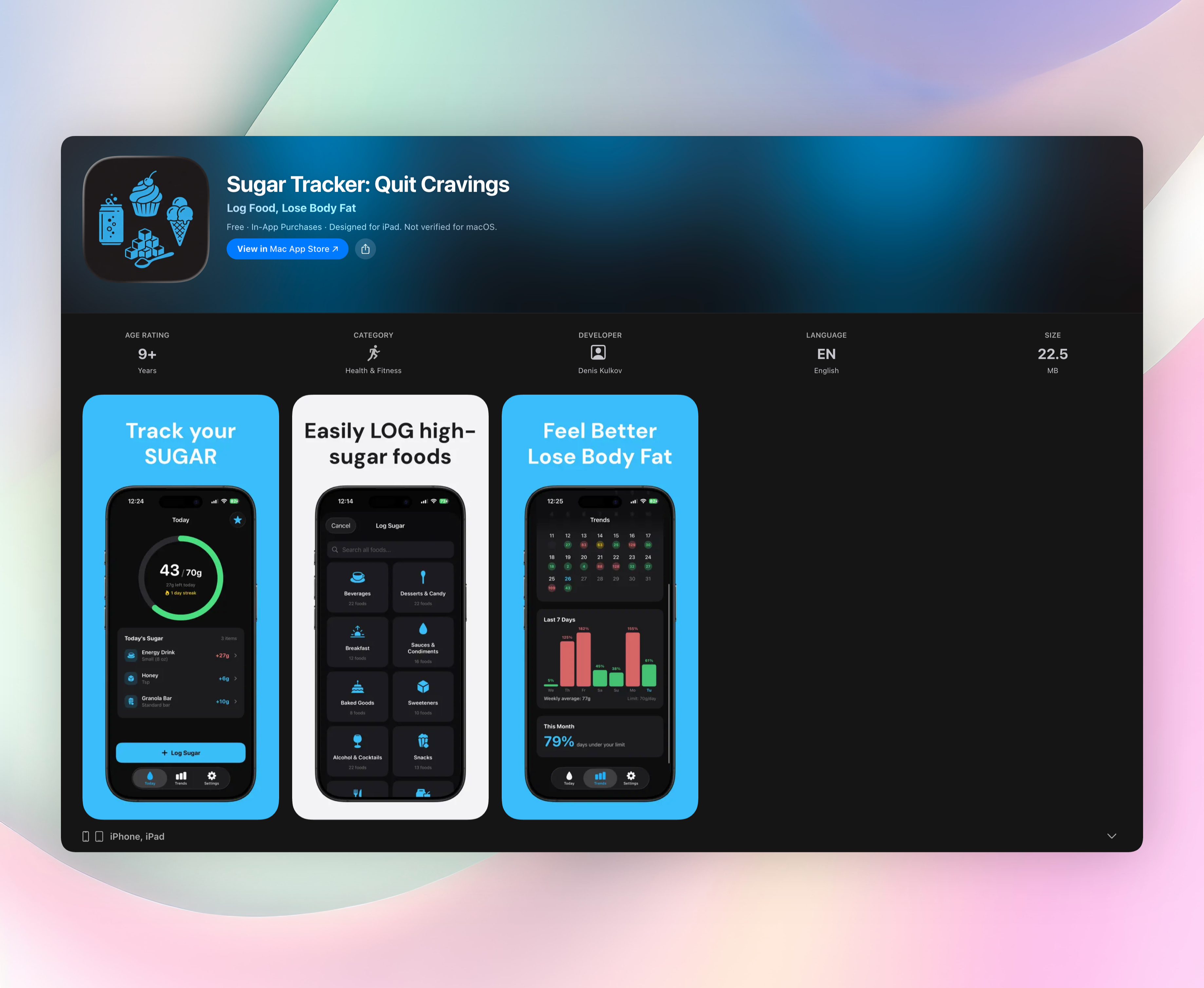
Running that subtraction in your head across a whole day is where most people lose the thread. Sugar Tracker is an added-sugar tracking app for iPhone, which turns the 25 g or 36 g ceiling into a live number you check rather than one you recalculate at every snack.
Why three different daily sugar intake numbers exist
The gap isn't a disagreement about sugar. It's three different questions.
The AHA figure comes from a discretionary-calorie argument: once nutrient needs are covered, only so many calories are left over for foods that supply energy and little else, and added sugar shouldn't claim more than roughly half of that room. Women's average calorie needs are lower, so the allowance is lower.
The WHO figure rests on evidence about body weight and dental caries. It's a percentage because a fixed gram target would be punishing for a large adolescent athlete and generous for a small sedentary adult. The below-5% level is explicitly labeled conditional — the supporting evidence, largely from dental studies, was graded lower quality than the evidence behind the 10% cap.
The FDA figure exists to make a label function. A %DV needs one denominator that applies to every shopper, so the agency picked 10% of a 2,000-calorie reference diet and stopped there.
There's also a definitional split underneath all of it. WHO governs free sugars: added sugars plus the sugars naturally present in honey, syrups, fruit juice and fruit juice concentrate. The US added-sugars definition treats 100% fruit juice as containing zero added sugars. An 8-ounce glass of orange juice reads 0 g added sugars on a US label while counting as roughly 21 grams of free sugars under WHO.
Recommended daily sugar intake by calorie level
WHO's percentages applied to three common calorie levels:
- 1,500 calories — 10% is 37.5 g (about 9 tsp); 5% is about 19 g (4.5 tsp)
- 2,000 calories — 10% is 50 g (12 tsp); 5% is 25 g (6 tsp)
- 2,500 calories — 10% is 62.5 g (about 15 tsp); 5% is about 31 g (7.5 tsp)
Notice the overlap: WHO's 5% ideal on a 2,000-calorie day lands exactly on the AHA's 25 grams for women. At the 10% level the two frameworks separate by a factor of two, which is why published answers to how much sugar per day vary so widely.
What 25 or 36 grams looks like in real food
A 12-ounce can of regular cola carries 39 grams of added sugar. That's more than a woman's entire daily allowance under the AHA and essentially all of a man's. A 20-ounce bottle runs about 65 grams, past even the 50-gram label DV.
Other reference points, using typical US labels:
- A standard 1.55-ounce milk chocolate bar: about 24 g of sugar
- A tablespoon of ketchup: about 4 g, or one teaspoon of sugar
- A tablespoon of honey: about 17 g
- Sweetened flavored yogurt: often 10–20 g per cup, while plain versions have none added
- Large sweetened coffee drinks: frequently 30–50 g
Federal dietary-intake data puts the average US adult near 17 teaspoons of added sugar a day, roughly 70 grams — close to triple the AHA's figure for women.
How much added sugar per day for kids and teens
The AHA's 2016 statement on children uses one number across ages 2 through 18: under 25 grams (6 teaspoons) of added sugars a day, with sugar-sweetened drinks held to no more than one 8-ounce serving per week. Below age 2 the recommendation is none at all, a position the Dietary Guidelines for Americans share — added sugars displace nutrient-dense food quickly in a very small diet.
The Dietary Guidelines apply their "less than 10% of calories" cap from age 2 onward, which for a 1,400-calorie preschooler works out near 35 grams. That's looser than the AHA's flat 25, and the two are often quoted side by side without the difference being flagged.
The limit covers added sugar, not the sugar in fruit and milk
Every number above applies to added sugar rather than total sugar, and that distinction moves the arithmetic more than any gap between the guidelines does.
Added sugars are the ones introduced during processing, preparation or at the table: cane and brown sugar, corn syrup, high-fructose corn syrup, honey, agave, maple syrup, fruit juice concentrate, and most of the -ose words on an ingredient list. Naturally occurring sugars are excluded — the fructose in a whole apple, the lactose in plain milk and unsweetened yogurt.
A US Nutrition Facts panel separates them for you. "Total Sugars" sits above an indented "Includes X g Added Sugars" line, and only that second line counts against 25 or 36 grams. A cup of plain milk shows about 12 g total sugars and 0 g added. Whole fruit carries no panel at all and no added sugar.
The ambiguous cases are juice and dried fruit. Under the US definition, 100% juice and unsweetened dried fruit contribute no added sugars; under WHO's free-sugars definition, juice counts in full while dried fruit does not. If you're tracking against the AHA number, follow the label. If you're tracking against WHO, add your juice back in.
FAQ
How much sugar per day for a woman?
The AHA's figure for most women is 25 grams of added sugar — 6 teaspoons, or 100 calories. WHO gives a range instead: under 50 grams on a 2,000-calorie day, ideally under 25. The stricter end of the two frameworks agrees on 25 g.
Is 50 grams of sugar a day too much?
It depends which document you're reading. Fifty grams is the FDA's label Daily Value and matches WHO's 10% cap on a 2,000-calorie day, so it isn't over the line by those standards. It is double the AHA's limit for women and roughly 40% above its limit for men.
How many teaspoons is 25 grams of sugar?
About 6 teaspoons. A level teaspoon of granulated sugar weighs roughly 4.2 grams, so 25 ÷ 4.2 comes to 5.95. Rounding to 4 g per teaspoon gives 6.25 instead. The difference is small enough that guidelines print 25 g and 6 tsp as equivalents.
Does fruit count toward the daily sugar limit?
Whole fruit doesn't count under either the US or the WHO definition. Fruit juice is where they split: the US label reports 100% juice as zero added sugars, while WHO counts it as a free sugar. Dried fruit with no sweetener added is treated like whole fruit on a US label.
Free Sugar tools
- A1C CalculatorUse this a1c calculator to convert an A1C percentage to estimated average glucose, or enter average glucose to estimate A1C in both common units.
- Banana Carb and Sugar CalculatorFind how many carbs are in a banana by size, quantity and ripeness. Compare total and net carbs, sugar, fibre, calories and carb exchanges.
- Blood Sugar Level ChartEnter a blood glucose reading, unit and test context to see the published range, a chart position and the same value in the other unit.
- Blood Sugar Unit ConverterConvert blood sugar between mg/dL and mmol/L in seconds, with a two-column reference table for common readings.
- Daily Sugar Limit CalculatorEstimate a daily added-sugar limit in grams and teaspoons from your age, sex and calorie target.
- Sugar Cube Grams CalculatorFind how many grams of sugar are in a sugar cube by entering the number of cubes and grams per cube. Get the total sugar and an optional teaspoons equivalent.
- Sugar Grams to Teaspoons ConverterHow many grams is a teaspoon of sugar? A level teaspoon of granulated white sugar weighs about 4.2 g, while nutrition labels round it to 4 g. Convert either way, pick your sugar type, and see how the result compares with the American Heart Association daily added-sugar limits.