
Added sugar vs natural sugar: how to tell them apart
Added sugar is any sugar put into a food during processing or preparation — table sugar, but also honey, maple syrup, agave, and fruit-juice concentrate. Natural sugar is what the whole food already contained: lactose in plain milk, fructose in an apple. Only the added kind counts against published daily limits.
Added sugar vs natural sugar: where the line actually falls
The split isn't chemical. Sucrose from cane and sucrose from a peach are the same molecule, and the gut breaks both into glucose and fructose. What differs is the delivery — what else shows up alongside the sugar.
Regulators drew the line at origin instead. The FDA defines added sugars as sugars added during processing or packaging, sugars from syrups and honey, and sugars from concentrated fruit or vegetable juices beyond what the same volume of 100% juice of that type would naturally contain. Everything else on the sugar line came with the ingredient.
What is added sugar on an ingredient list
Manufacturers rarely just write "sugar." The usual names: cane sugar, evaporated cane juice, brown sugar, corn syrup, high-fructose corn syrup, dextrose, maltose, malt syrup, molasses, honey, agave nectar, coconut sugar, fruit juice concentrate. Ingredients are listed in descending order by weight, so three sweeteners sitting in positions four, six, and nine can together outweigh anything above them.
Pure honey and maple syrup sold as themselves are a labeling oddity. FDA guidance lets a single-ingredient jar skip the "Includes Xg Added Sugars" grams and carry a symbol with an explanatory footnote instead — nothing was added to anything. Stir that same honey into yogurt and every gram of it becomes added sugar on the yogurt's label.
What counts as natural sugar
Three sources, essentially:
- Lactose in plain milk, plain yogurt, and kefir — roughly 12 g per cup of milk. Lactose is far less sweet than table sugar, which is why plain milk doesn't taste sugary despite the number.
- Fructose, glucose, and sucrose in whole fruit, and smaller amounts in vegetables. A medium apple runs around 19 g.
- Trace amounts in grains, nuts, and legumes.
None of it gets its own row. A US label has no "natural sugars" line — natural sugar is simply what's left when you subtract added sugars from total sugars.
Total sugars vs added sugars on the label
Total Sugars sits under Total Carbohydrate with no %DV, because no authority sets a target for all sugar combined. Indented beneath it, "Includes Xg Added Sugars" carries a %DV measured against a Daily Value of 50 g.
Yogurt makes it concrete. A plain cup might read 12 g Total Sugars and 0 g Added Sugars — all lactose, none of it added. The vanilla version of the same yogurt might read 19 g total and 7 g added: the same 12 g of lactose, plus 7 g of cane sugar. Total sugars rose by half; the number that counts against a limit went from zero to about 14% of the Daily Value.
| Food (typical serving) | Total sugars | Added sugars |
|---|---|---|
| Plain milk, 1 cup | ~12 g | 0 g |
| Chocolate milk, 1 cup | ~24 g | ~12 g |
| Plain yogurt, 1 cup | ~12 g | 0 g |
| Vanilla yogurt, 1 cup | ~19 g | ~7 g |
| Medium apple | ~19 g | 0 g |
| 100% orange juice, 8 oz | ~21 g | 0 g |
| Cola, 12 oz | ~39 g | ~39 g |
These are typical values, not fixed ones. Two brands of the same product can differ by several grams, and the label on the package is the only authority for that package.
Why the same grams behave differently
Fiber, water, and structure are doing most of the work. An apple's sugar is locked inside cell walls that have to be chewed apart and then digested, and it arrives with about 4 g of fiber and a lot of water. That slows how fast the sugar reaches the bloodstream and fills the stomach along the way. Juice the apple and the fiber and the chewing both disappear; the sugar is already in solution.
Volume matters as much as chemistry. Eating 39 g of sugar as whole fruit takes roughly two medium apples and real effort. Drinking it takes one can and about ninety seconds. Milk's lactose comes bundled with protein and fat, which is a slower package again.
So the case for the distinction isn't that fruit fructose is a different substance. It's that foods carrying natural sugar are hard to overeat and bring nutrients along, while most added sugar arrives in forms built to go down easily.
Does natural sugar count toward the daily limit?
Under US guidance, no. The American Heart Association's suggested ceilings — about 25 g of added sugar a day for women and 36 g for men — apply to added sugars only, as does the Dietary Guidelines for Americans recommendation to keep added sugars under 10% of daily calories for ages 2 and up. Lactose in milk and fructose in fruit sit outside both numbers.
WHO draws its line slightly differently. It uses "free sugars," which covers added sugars plus the sugars naturally present in honey, syrups, fruit juices, and fruit-juice concentrates, and recommends keeping them under 10% of total energy, with a conditional suggestion of under 5%. The practical consequence: a glass of 100% orange juice reads 0 g added sugars on a US label but counts as free sugar to WHO. Whole fruit and plain milk are outside the limit under both systems. If you're working out where your own number lands, how many grams of sugar per day walks through the calculation.
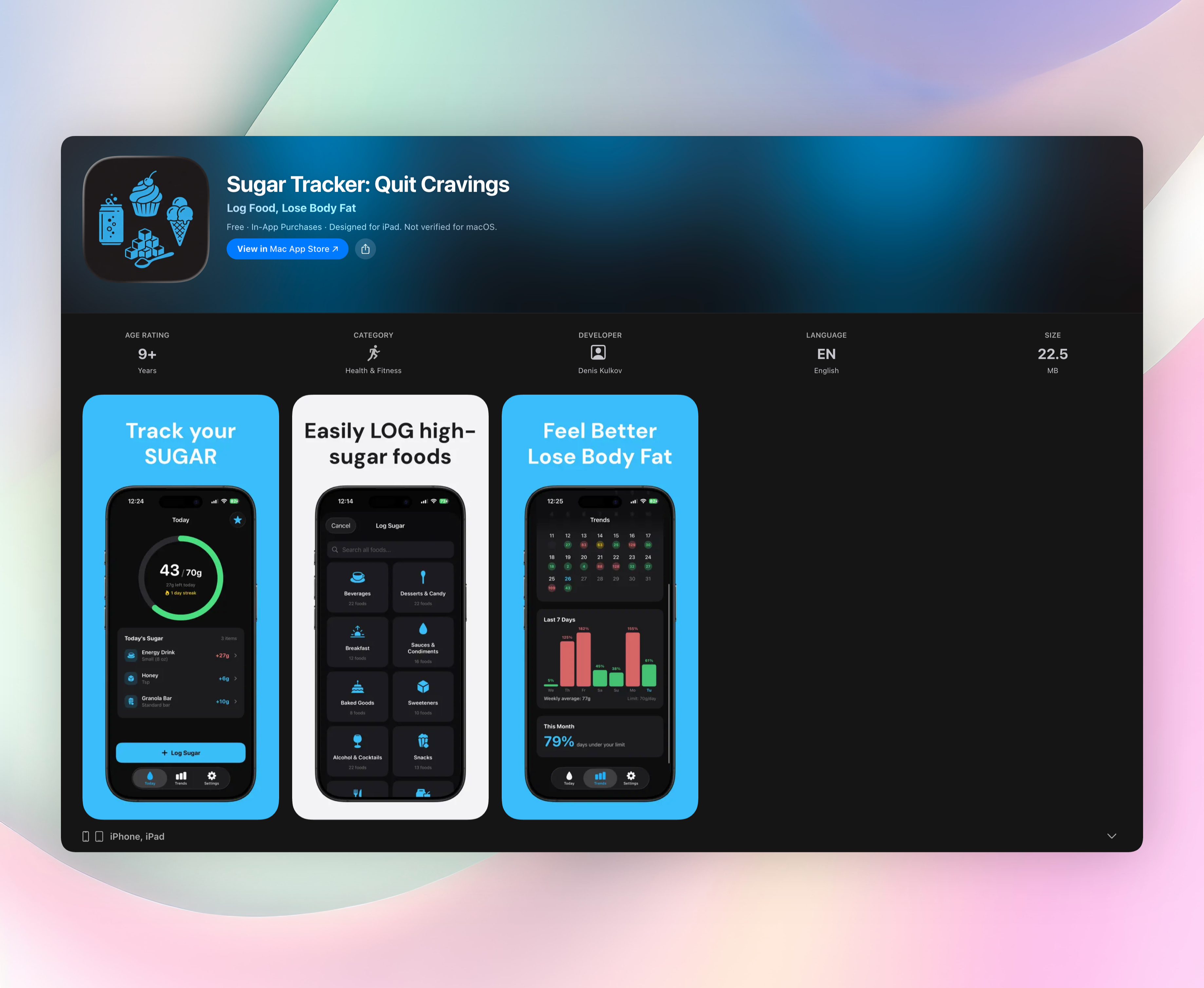
That distinction is easy to lose the moment you start counting. Sugar Tracker, an added-sugar tracking app for iPhone, logs added grams separately from total sugars, so a bowl of berries doesn't eat the day's allowance.
How much natural sugar per day is reasonable
No major guideline sets a gram cap on natural sugar, which is why the question rarely gets a straight answer. The guidance is framed as food amounts instead: the Dietary Guidelines suggest about 2 cups of fruit and 3 cup-equivalents of dairy a day for most adults, and recommend that most fruit come from whole fruit rather than juice. Hit those targets with an ordinary mix of fruits and dairy and the natural sugar involved adds up to well past any added-sugar ceiling on the market — without a single guideline asking anyone to track it.
The exception worth watching is juice, since it clears the added-sugar test on a technicality while behaving much more like a sweetened drink than like fruit.
FAQ
Is natural sugar bad for you?
Published guidelines don't limit it. The sugar in whole fruit and plain dairy comes with fiber, water, protein, or micronutrients, and neither the AHA nor WHO asks people to restrict it. The caveats are dose and form — dried fruit concentrates a lot of sugar into a small volume, and juice removes the fiber entirely.
Does milk have added sugar?
Plain milk has none. Its roughly 12 g per cup is lactose, and the label reads 0 g Added Sugars. Flavored milks are different: chocolate milk typically doubles the total, and about half of that shows up on the added sugars line.
Is honey an added sugar?
Yes, whenever it's an ingredient in something else. Honey, maple syrup, agave, and fruit-juice concentrate all count as added sugars under FDA rules and as free sugars under WHO's, regardless of how unrefined they are. Only a single-ingredient jar of pure honey gets the footnote treatment.
Does 100% fruit juice count as added sugar?
Not on a US Nutrition Facts label — 100% juice with nothing added declares 0 g added sugars. WHO counts it as a free sugar, and the Dietary Guidelines advise limiting how much of the daily fruit target comes from juice. It's the clearest case where the two systems disagree.
How do I find the natural sugar in a food?
Subtract Added Sugars from Total Sugars; the remainder is the naturally occurring share. Fiber has its own line under Total Carbohydrate and isn't part of the sugar figure at all.
Free Sugar tools
- A1C CalculatorUse this a1c calculator to convert an A1C percentage to estimated average glucose, or enter average glucose to estimate A1C in both common units.
- Banana Carb and Sugar CalculatorFind how many carbs are in a banana by size, quantity and ripeness. Compare total and net carbs, sugar, fibre, calories and carb exchanges.
- Blood Sugar Level ChartEnter a blood glucose reading, unit and test context to see the published range, a chart position and the same value in the other unit.
- Blood Sugar Unit ConverterConvert blood sugar between mg/dL and mmol/L in seconds, with a two-column reference table for common readings.
- Daily Sugar Limit CalculatorEstimate a daily added-sugar limit in grams and teaspoons from your age, sex and calorie target.
- Sugar Cube Grams CalculatorFind how many grams of sugar are in a sugar cube by entering the number of cubes and grams per cube. Get the total sugar and an optional teaspoons equivalent.
- Sugar Grams to Teaspoons ConverterHow many grams is a teaspoon of sugar? A level teaspoon of granulated white sugar weighs about 4.2 g, while nutrition labels round it to 4 g. Convert either way, pick your sugar type, and see how the result compares with the American Heart Association daily added-sugar limits.