
How to read a nutrition label for added sugar
Learning how to read a nutrition label for added sugar comes down to two places: one indented line in the panel, and the ingredient list. The line gives a number measured against a 50 g daily reference. The list tells you which of sugar's many names it arrived under.
Start with the serving size, because everything scales to it
Every figure in the Nutrition Facts panel is per serving, and "servings per container" sits right above it. A pint of ice cream listing 3 servings means the added-sugar number triples if you finish the tub.
The 2016 label redesign — on packages from most large manufacturers since January 2020, smaller ones since 2021 — enlarged the calorie figure, updated serving sizes to reflect what people actually eat, and introduced the Added Sugars line. Some mid-size packages now carry a dual-column label showing per serving and per package side by side.
Reading added sugars on the nutrition label
Work down the carbohydrate block and watch the indentation — it tells you which number belongs to which:
- Total Carbohydrate — the parent line, in grams, with a %DV.
- Dietary Fiber — indented one level.
- Total Sugars — indented, grams only, no %DV. There's no established daily reference value for total sugars, so the column is blank.
- Includes Xg Added Sugars — indented one level further, with its own %DV.
That last line is the centerpiece. Added sugars are the ones introduced during processing or packaging: table sugar, syrups, honey, and sugars from concentrated fruit or vegetable juice beyond what an equal volume of 100% juice would supply. The lactose in plain milk and the fructose in a whole apple are not added sugars and never show up on that line. The full split is covered in added sugar vs natural sugar.
What the %DV on that line means
The FDA's Daily Value for added sugars is 50 g, which is 10% of calories on a 2,000-calorie diet. The percentage is just grams divided by 50. A bar with 12 g added sugars reads 24% DV.
Two shortcuts make that usable. FDA's general guidance treats 5% DV or less of a nutrient as low and 20% DV or more as high. And roughly 4 g of sugar is a teaspoon, so 12 g is three teaspoons stirred into one bar.
The 50 g is a labeling reference, not a recommendation. Published guidelines sit lower: the World Health Organization advises keeping free sugars under 10% of daily energy, with a conditional further reduction to 5%, and the American Heart Association suggests a ceiling near 25 g a day for women and 36 g for men. The daily added-sugar limits in grams compare them directly.
Two exceptions on the panel
Honey and pure maple syrup, sold as single-ingredient products, use a symbol beside the Added Sugars %DV instead of a gram figure — a footnote clarifies the sugars are inherent, not added during processing.
Sugar alcohols (erythritol, xylitol, maltitol, sorbitol) and allulose aren't counted as added sugars. They fall under Total Carbohydrate, which is how a product reads 0 g added sugars and still tastes sweet.
Other names for sugar in the ingredient list
The panel tells you how much. The ingredient list tells you what form it took and where it sits. Ingredients appear in descending order by weight, so position carries information — and that's what makes the different names for sugar useful to a formulator. Split one sweetener into three and each lands lower on the list than the combined amount would have. Three syrups in positions five, seven, and nine can outweigh the single sugar sitting in position two.
Grouped, the hidden sugar names fall into predictable families:
- -ose endings: sucrose, glucose, fructose, dextrose, maltose, galactose, crystalline fructose.
- Syrups: corn syrup, high-fructose corn syrup, corn syrup solids, brown rice syrup, tapioca syrup, malt syrup, golden syrup, refiner's syrup, sorghum syrup.
- Juice concentrates: fruit juice concentrate, apple or white grape juice concentrate, fruit juice crystals, date paste.
- Malt and molasses: barley malt, malt extract, malted barley, molasses, blackstrap molasses, treacle.
- Nectars and honeys: agave nectar, agave syrup, honey, maple syrup, coconut nectar.
- Crystallized cane and beet: cane sugar, raw sugar, turbinado, demerara, muscovado, panela, coconut sugar, date sugar, beet sugar, invert sugar.
"Evaporated cane juice" is one to recognize on sight. FDA guidance treats it as a misleading name — the ingredient is sugar, and the agency asks for "cane sugar" — though the old wording still turns up on shelves.
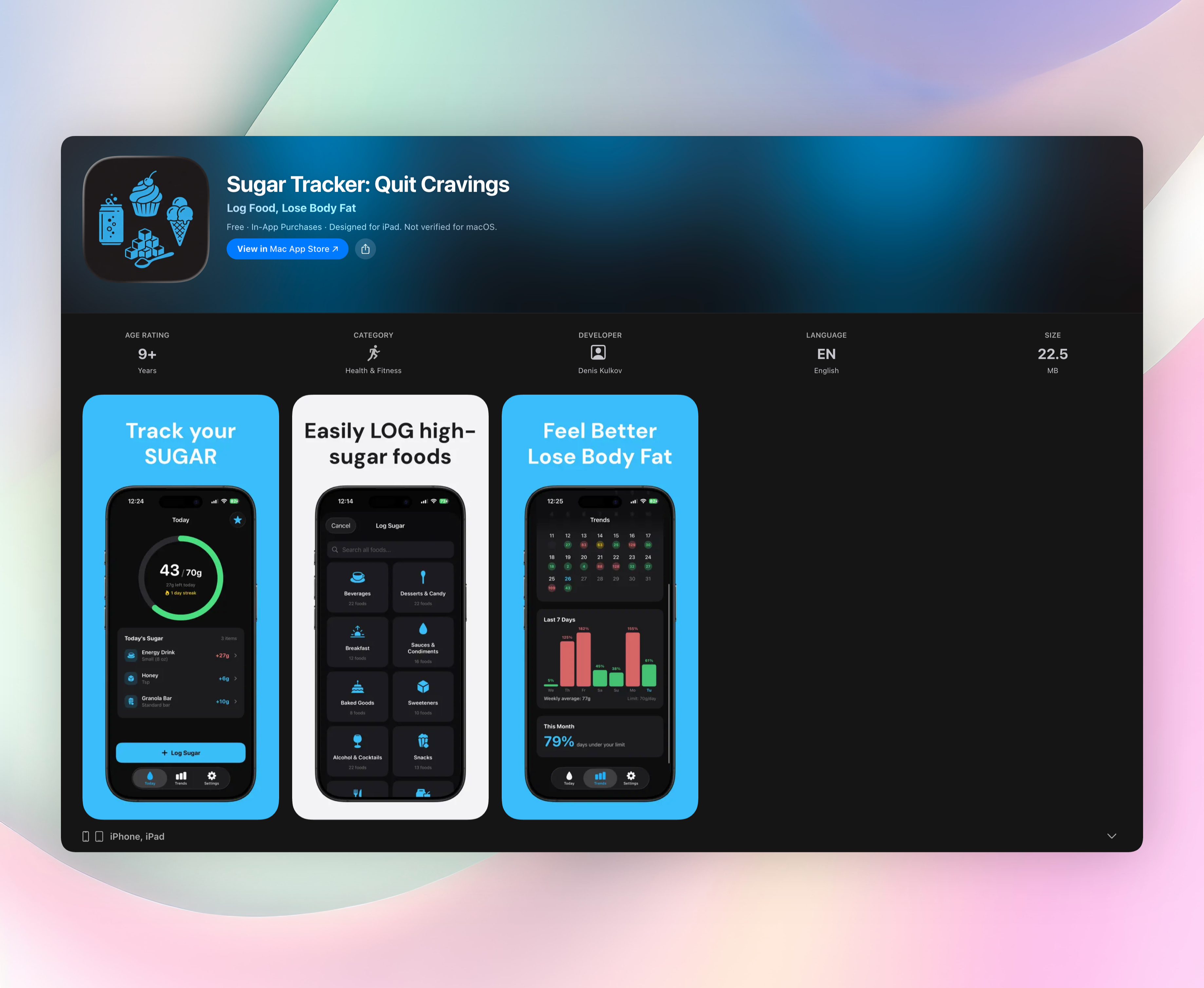
Adding up three syrups in one ingredient list is arithmetic worth doing once rather than every shopping trip. Logging an item in Sugar Tracker, an added-sugar tracking app for iPhone, keeps that number attached to the product instead of to your memory of the aisle.
Foods with hidden sugar that never taste sweet
Soda, candy, and cookies don't need a label check. These do:
- Sandwich bread. Sugar, HFCS, or honey commonly sits in the first several ingredients; it feeds the yeast and browns the crust.
- Pasta sauce. Sugar offsets tomato acidity, and jarred marinara varies enormously between brands.
- Salad dressing. Anything labeled honey, balsamic glaze, or fat free — removing fat usually means adding sugar for body.
- Ketchup and barbecue sauce. Ketchup is sweetened by design; BBQ sauce often lists molasses or corn syrup near the top.
- Granola and cluster cereals. Clusters need a syrup binder, and the serving sizes are small.
- Protein bars. Brown rice syrup and cane sugar are standard binders, and the protein figure pulls attention off the added-sugar line.
- Flavored yogurt. Carries both lactose (natural) and fruit prep (added); only the indented line separates them.
- Plant milks. "Original" is usually sweetened, with the unsweetened version beside it in near-identical packaging.
- Instant oatmeal and flavored grain pouches. The flavor sachet is largely sugar.
- Jerky and marinades. Sugar is part of the cure.
What "no added sugar," "sugar free," and "unsweetened" mean
Three of these four are defined in federal regulation, and they do not mean the same thing.
| Front-of-pack claim | What it requires | The catch |
|---|---|---|
| Sugar free (also zero sugar, no sugar, sugarless) | Under 0.5 g of sugars per labeled serving and per reference amount | Silent on calories and on the sweeteners used instead; if the food isn't low- or reduced-calorie, the label must disclose that |
| No added sugar / no sugar added | No sugars or sugar-bearing ingredients such as jam, jelly, or fruit juice concentrate added in processing or packaging, sugars not raised by other means, and the food it substitutes for normally contains added sugar | Naturally occurring sugars can still be high — dried fruit, juice — and the label must point you to the panel unless it's also low- or reduced-calorie |
| Reduced sugar / less sugar | At least 25% less sugars per reference amount than a named comparison food | The comparison food may have been very high to begin with |
| Unsweetened | Not a defined nutrient content claim — a description of no added sweeteners | Confirm on the Added Sugars line and the ingredients, not the front panel |
So what does "no added sugar" mean in practice: nothing sweet was added, though the product may still carry plenty of sugar from its own ingredients.
How to read a nutrition label in 30 seconds
- Serving size and servings per container.
- The indented Includes Xg Added Sugars line and its %DV.
- Divide grams by 4 for teaspoons if the number feels abstract.
- Scan the ingredients for the sugar families and count them — don't stop at the first.
- Treat a front-of-pack claim as a reason to check the panel, not a replacement for it.
FAQ
What does "no added sugar" mean on a nutrition label?
No sugars or sugar-bearing ingredients were added during processing or packaging, and the sugars weren't raised by other means such as enzyme treatment. It doesn't mean low sugar or low calorie — a no-added-sugar dried fruit bar can carry more sugar than a cookie, all of it naturally occurring.
Where are added sugars on the nutrition label?
On the indented "Includes Xg Added Sugars" line directly beneath Total Sugars, inside the Total Carbohydrate block. It's the only sugar line with a %DV beside it.
Does Total Sugars include added sugars?
Yes — it's the sum of naturally occurring and added sugars, which is why it carries no %DV. Subtract the added sugars figure to see how much came from the food itself.
What are the different names for sugar in an ingredient list?
Dozens, in a few recognizable families: -ose endings (sucrose, dextrose, maltose), syrups (corn, brown rice, malt, tapioca), juice concentrates, molasses and treacle, nectars, and crystallized cane names such as turbinado, demerara, and muscovado.
Is 50 g of added sugars a daily target?
No. It's the FDA's labeling reference for a 2,000-calorie diet, used to calculate the %DV. WHO and American Heart Association guidelines set lower thresholds for daily added or free sugar intake.
Free Sugar tools
- A1C CalculatorUse this a1c calculator to convert an A1C percentage to estimated average glucose, or enter average glucose to estimate A1C in both common units.
- Banana Carb and Sugar CalculatorFind how many carbs are in a banana by size, quantity and ripeness. Compare total and net carbs, sugar, fibre, calories and carb exchanges.
- Blood Sugar Level ChartEnter a blood glucose reading, unit and test context to see the published range, a chart position and the same value in the other unit.
- Blood Sugar Unit ConverterConvert blood sugar between mg/dL and mmol/L in seconds, with a two-column reference table for common readings.
- Daily Sugar Limit CalculatorEstimate a daily added-sugar limit in grams and teaspoons from your age, sex and calorie target.
- Sugar Cube Grams CalculatorFind how many grams of sugar are in a sugar cube by entering the number of cubes and grams per cube. Get the total sugar and an optional teaspoons equivalent.
- Sugar Grams to Teaspoons ConverterHow many grams is a teaspoon of sugar? A level teaspoon of granulated white sugar weighs about 4.2 g, while nutrition labels round it to 4 g. Convert either way, pick your sugar type, and see how the result compares with the American Heart Association daily added-sugar limits.