
What is maltodextrin? Decoding sugar names on labels
Maltodextrin is a starch-derived powder — usually from corn, rice, potato, or wheat — built from short chains of glucose. It digests fast, with a glycemic index commonly reported between 85 and 105, against roughly 65 for table sugar. On US labels it counts as a carbohydrate, not an added sugar.
What is maltodextrin made from?
Manufacturers hydrolyze starch partway to glucose using acid or enzymes, breaking long chains into shorter ones, then spray-dry the result into a white, nearly flavorless powder.
How far the breakdown went is measured as dextrose equivalent, or DE. Maltodextrin sits in the DE 3–20 range; past DE 20 the same process yields glucose syrup or corn syrup solids instead. Low-DE maltodextrin barely tastes sweet, which is why it works as a bulking agent, thickener, and flavor carrier in powders.
The absence of sweetness is the confusing part: your tongue reads neutral, your gut reads glucose, since digestive enzymes work through short chains fast.
One exception matters. Resistant maltodextrin, also sold as resistant dextrin or soluble corn fiber, is processed so most of it survives digestion intact, and FDA permits it to be declared as dietary fiber. Same word in the ingredient list, different behavior.
Why maltodextrin skips the Added Sugars line
A US Nutrition Facts panel counts Total Sugars as mono- and disaccharides — glucose, fructose, galactose, sucrose, lactose, maltose. Added Sugars is the subset introduced during processing, plus sugars from syrups, honey, and fruit or vegetable juice concentrates beyond what an equal volume of 100% juice would supply.
Maltodextrin's chains run longer than two units, so it fails that definition and lands in Total Carbohydrate instead — 4 calories per gram, same as sugar, with a glucose response that often outpaces it. A product can be built largely on maltodextrin and still print 0 g next to Includes Added Sugars — not a labeling error.
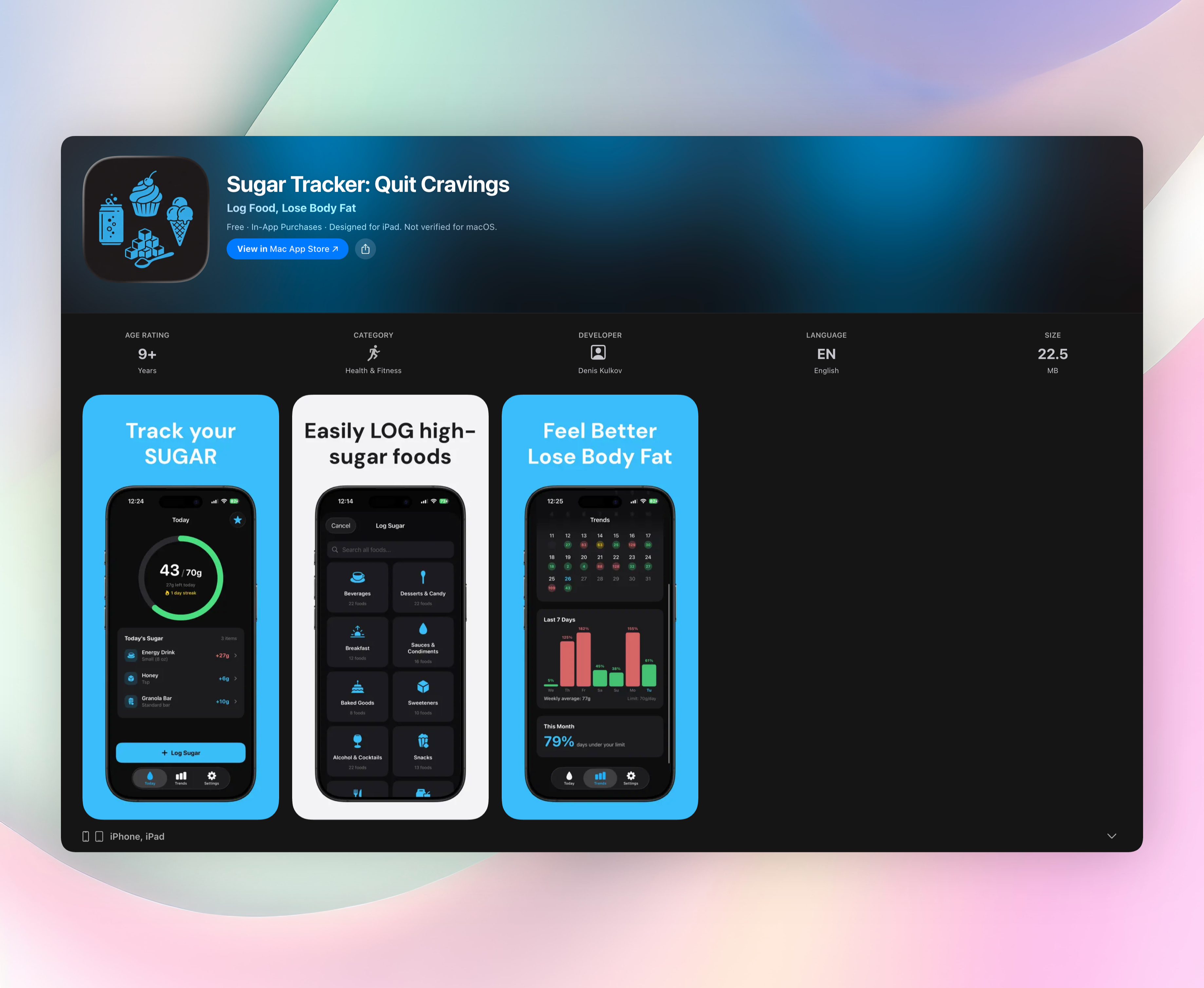
If you keep a running total, that gap is worth knowing about. Sugar Tracker is an added-sugar tracking app for iPhone, so the day's number comes from the foods you log rather than from how each manufacturer chose to declare an ingredient.
Two panel quirks compound it: the Added Sugars %DV assumes 50 g a day, and anything under 0.5 g per serving rounds to zero, flattening a line a real portion wouldn't.
Invert sugar, dextrose, and cane juice
What is invert sugar?
Invert sugar is sucrose split into its two halves, glucose and fructose, by acid or the enzyme invertase. It's slightly sweeter than sucrose, holds moisture, and resists crystallizing — useful in candy, ice cream, syrups, and commercial baking. It counts as an added sugar.
Is dextrose sugar?
Yes. Dextrose is D-glucose, usually sold as dextrose monohydrate, and glucose is the reference point the glycemic index scale is built on at GI 100. Per gram it tastes less sweet than sucrose, so it appears where sweetness isn't the goal: cured meats, baked goods, sports drinks, and the bulking powder inside tabletop sweetener packets. Monosaccharide, so it lands on the Added Sugars line.
What is cane juice?
Cane juice is the liquid pressed from sugarcane, and "evaporated cane juice" was the label term for its dried, lightly refined form. FDA's 2016 final guidance concluded the phrase wasn't truthful and non-misleading, since the ingredient is a sugar rather than a juice, and advised declaring it as "cane sugar" or "sugar." Chemically it's sucrose carrying a trace of molasses.
Fruit juice concentrate
Juice concentrate used as a sweetener — apple, pear, and white grape are the usual ones — counts as added sugar. The exception is 100% juice reconstituted from its own concentrate, where the sugar is native to the fruit. That's the subject of added sugar vs natural sugar.
| Ingredient | What it is | Blood glucose | Where it shows up | Added Sugars line? |
|---|---|---|---|---|
| Maltodextrin | Polysaccharide, DE 3–20 | Fast; GI usually 85–105 | Sports drinks, seasoning powders, instant mixes | No |
| Invert sugar | Glucose + fructose from split sucrose | Close to sucrose | Candy, ice cream, syrups, bakery | Yes |
| Dextrose | Monosaccharide (D-glucose) | GI 100, the reference | Cured meats, sports drinks, sweetener packets | Yes |
| Evaporated cane juice | Sucrose with trace molasses | Close to table sugar | Baked goods, sauces, drinks — now labeled "cane sugar" | Yes |
| Fruit juice concentrate | Concentrated fruit sugars | Close to sucrose | "No added sugar" bars, sauces, drinks | Yes, unless it's 100% juice |
Reading sugar names on labels
Ingredients list by weight, descending — so a manufacturer can split one sweetener into sugar, brown rice syrup, and juice concentrate, and each sits lower than their combined weight would.
Lists titled "56 names for sugar" circulate widely; the count depends on who's counting, and memorizing it isn't the point. Three patterns cover most of what you'll meet:
- -ose endings — sucrose, dextrose, fructose, maltose, lactose.
- Syrups and nectars — corn syrup, high-fructose corn syrup, brown rice syrup, tapioca syrup, agave nectar, malt syrup.
- Cane and juice words — cane sugar, cane juice, muscovado, panela, turbinado, fruit juice concentrate.
Read that list against the Added Sugars number: a long sweetener list beside a low figure usually means a polysaccharide like maltodextrin. For the panel mechanics, see how to read a nutrition label.
Published guidelines target free or added sugars specifically: WHO recommends adults hold free sugars under 10% of daily energy, with a conditional further reduction below 5%, and the American Heart Association suggests roughly 25 g a day for women and 36 g for men. Maltodextrin doesn't count against those figures as written, even when it moves blood glucose more than the sugar that does. Daily added-sugar limits in grams works through how the targets compare.
FAQ
Is maltodextrin an added sugar?
Not under US labeling rules. It's a polysaccharide, and both Total Sugars and Added Sugars count only mono- and disaccharides, so maltodextrin is declared inside Total Carbohydrate. It still supplies 4 calories per gram and raises blood glucose quickly.
Does maltodextrin raise blood sugar more than sugar?
Usually. Reported GI values for maltodextrin generally sit between 85 and 105 while sucrose lands near 65, largely because half of sucrose is fructose, which has little immediate effect on blood glucose. Real response varies with the product and the portion.
Is maltodextrin the same as corn syrup solids?
They come off the same process, split by dextrose equivalent: below DE 20 it's maltodextrin, at DE 20 and above it's glucose syrup or corn syrup solids — and those count as added sugars.
Why did evaporated cane juice disappear from ingredient lists?
FDA's 2016 guidance found the term misleading, on the grounds that the ingredient is a sugar rather than a juice, and advised declaring it as "cane sugar" or "sugar." Most products changed the panel, not the recipe.
Free Sugar tools
- A1C CalculatorUse this a1c calculator to convert an A1C percentage to estimated average glucose, or enter average glucose to estimate A1C in both common units.
- Banana Carb and Sugar CalculatorFind how many carbs are in a banana by size, quantity and ripeness. Compare total and net carbs, sugar, fibre, calories and carb exchanges.
- Blood Sugar Level ChartEnter a blood glucose reading, unit and test context to see the published range, a chart position and the same value in the other unit.
- Blood Sugar Unit ConverterConvert blood sugar between mg/dL and mmol/L in seconds, with a two-column reference table for common readings.
- Daily Sugar Limit CalculatorEstimate a daily added-sugar limit in grams and teaspoons from your age, sex and calorie target.
- Sugar Cube Grams CalculatorFind how many grams of sugar are in a sugar cube by entering the number of cubes and grams per cube. Get the total sugar and an optional teaspoons equivalent.
- Sugar Grams to Teaspoons ConverterHow many grams is a teaspoon of sugar? A level teaspoon of granulated white sugar weighs about 4.2 g, while nutrition labels round it to 4 g. Convert either way, pick your sugar type, and see how the result compares with the American Heart Association daily added-sugar limits.