
Fructose vs glucose, and where every sweetener lands
Glucose and fructose carry the same calories and the same chemical formula, but not the same route through the body. Every cell can burn glucose; fructose is cleared mostly by the gut and liver. Table sugar is one of each bonded together, which makes the fructose vs glucose question narrower than it looks.
The fructose vs glucose difference is about destination, not calories
Glucose goes everywhere: muscle, brain, kidney, red blood cells. Insulin directs where it goes. A blood sugar reading is a glucose reading.
Fructose uses a different door. It's absorbed through its own transporter, GLUT5, and at modest doses metabolized largely by the cells lining the small intestine. Bigger doses exceed that capacity and reach the liver through the portal vein, where fructose is phosphorylated without the feedback brake that throttles glucose breakdown. That missing brake is why large fructose loads push the liver toward fat synthesis and raise uric acid production, and why fructose alone barely moves blood glucose or insulin. Its low glycemic index — roughly 15 to 25 against glucose's 100 — describes that detour, not a health advantage.
Sucrose is one glucose and one fructose, bonded
Table sugar is sucrose: a glucose molecule joined to a fructose molecule by a single bond. Sucrase splits that bond in the small intestine within minutes, so what gets absorbed is half glucose, half fructose. Cane sugar and beet sugar are both sucrose — same molecule, different crop, no nutritional difference. It's also why the line between added sugar and natural sugar is about the food around the sugar, not the sugar itself.
High fructose corn syrup vs sugar: a five-point gap
HFCS starts as corn starch broken down to glucose, part of it then converted to fructose. The number in the name is the fructose percentage of the sugars. HFCS-55, the soft-drink grade, is about 55% fructose and 42% glucose; HFCS-42, used in baked goods, canned fruit and many sauces, runs the other way.
So cane sugar vs high fructose corn syrup is 50% fructose against 55%, or against 42% depending on the grade. The other difference — HFCS arrives with its sugars already separated, sucrose with them bonded — is erased by sucrase almost immediately. Neither gap carries the health story that "no HFCS" labels imply, and a product that switches back to cane sugar rarely changes the grams.
Honey vs sugar, maple syrup vs sugar, and agave
Honey is a fructose-glucose mixture with water: roughly 38–40% fructose, 30–31% glucose, about 17% water, plus trace acids, enzymes and minerals. Slightly more fructose-dominant than table sugar, and already unbonded. A tablespoon of honey also weighs more than one of sugar — around 21 g against 12.5 g — so per spoon it delivers more sugar and more calories, not fewer.
Maple syrup's sugar is almost entirely sucrose, which makes it table sugar in liquid form. Its one honest nutritional feature is manganese, a meaningful share of the daily value per tablespoon, bought with roughly 52 calories of sugar.
Agave is the outlier, and not in the direction its shelf placement suggests. Processing converts its inulin into fructose, leaving a syrup typically 70–90% fructose, well above HFCS. Its very low glycemic index follows from that composition, not from anything good.
Brown sugar vs white sugar
Brown sugar is white sugar with molasses added back — roughly 3.5% by weight for light brown, about 6.5% for dark. The molasses carries calcium, potassium, magnesium and iron, which is why brown sugar registers minerals at all. The scale is the problem: about 11 mg of calcium per tablespoon, near 1% of a 1,000 mg day. It's a flavor and moisture choice.
Where each sweetener actually lands
| Sweetener | Fructose after digestion | Notable extras | Free/added sugar? |
|---|---|---|---|
| White, cane or beet sugar | 50% | None | Yes |
| Brown sugar | 50% | 3–6% molasses; ~1% DV calcium/tbsp | Yes |
| Maple syrup | ~50% (nearly all sucrose) | Water; manganese | Yes |
| HFCS-42 (baked goods) | ~42% | Water | Yes |
| HFCS-55 (soft drinks) | ~55% | Water | Yes |
| Honey | ~40% (already free) | ~17% water; trace minerals | Yes |
| Agave syrup | ~70–90% (already free) | Water | Yes |
The WHO groups every row above as free sugars — added sugars plus honey, syrups and fruit juice — and recommends holding them under 10% of daily energy, with a conditional recommendation of under 5%. The American Heart Association's guideline is no more than about 25 g a day for women and 36 g for men. On the US Nutrition Facts panel the added-sugars Daily Value is 50 g; single-ingredient honey and maple syrup carry a dagger footnote instead of a percentage, a labeling quirk rather than an exemption. For the arithmetic, see how many grams of sugar per day.
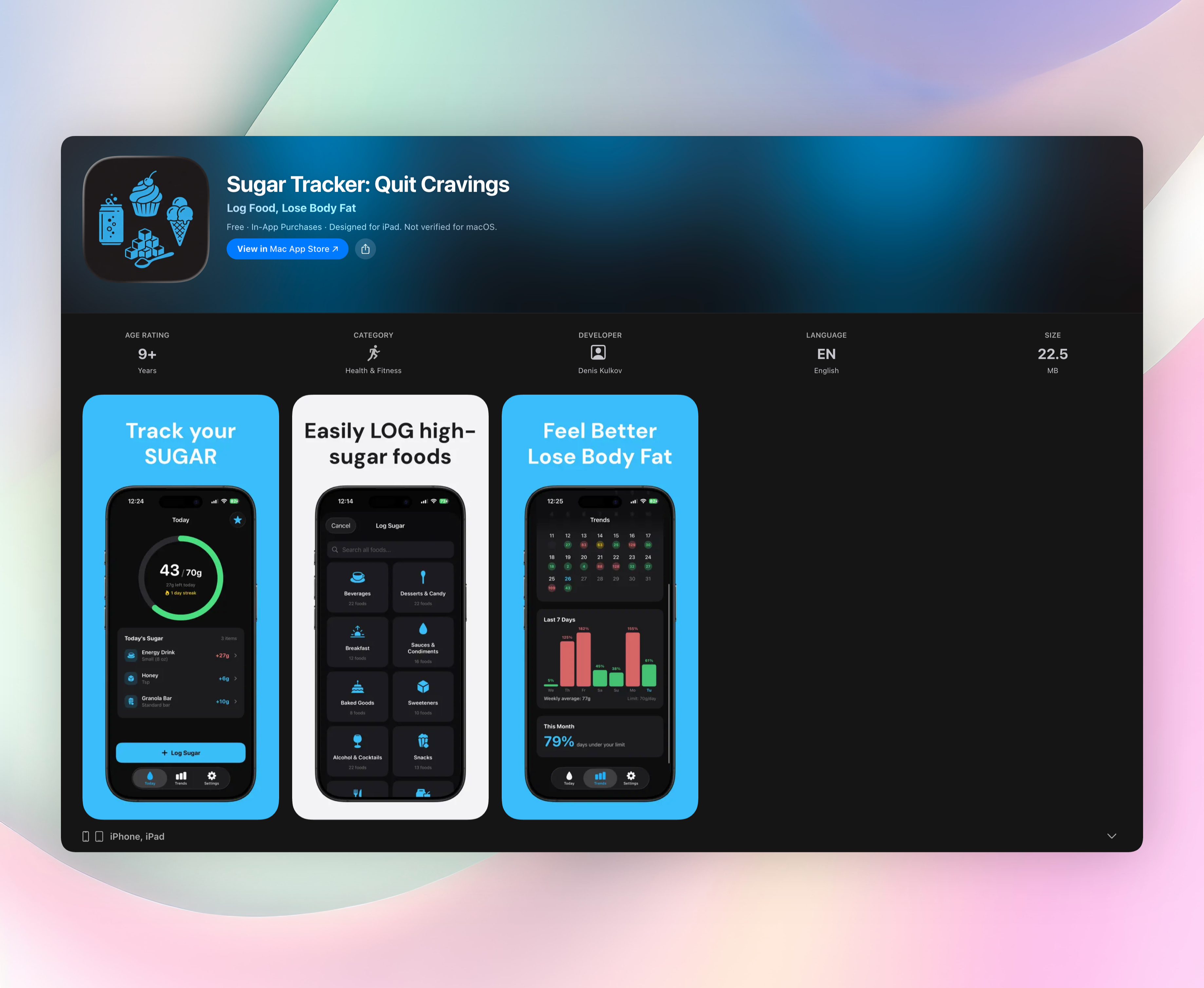
The variable that moves the total is the amount, not the source. Sugar Tracker, an added-sugar tracking app for iPhone, counts honey, agave and maple syrup the same way it counts table sugar, so a swap shows up in the day's grams instead of reading as a free pass.
FAQ
Is honey healthier than sugar?
Marginally at best, and not enough to change a daily total. Its minerals and enzymes come in quantities too small to count toward nutrient intake, and because honey is denser, a tablespoon carries more sugar and calories than a tablespoon of table sugar. The WHO counts honey as a free sugar alongside sucrose.
Is cane sugar better than high fructose corn syrup?
The measurable difference is a few percentage points of fructose: 50% for sucrose, about 55% for HFCS-55, about 42% for HFCS-42. Both end up absorbed as free glucose and fructose. Products that switch usually keep the same grams.
Does fructose raise blood sugar?
Very little on its own — its glycemic index is roughly 15 to 25, against 100 for glucose. It's handled by the gut and liver rather than circulating as blood sugar.
Which common sweetener has the least fructose?
Dextrose and brown rice syrup contain essentially none. Among the sweeteners people compare, HFCS-42 sits just below table sugar, honey further below that, sucrose-based options land at 50%, and agave sits far above the rest.
Free Sugar tools
- A1C CalculatorUse this a1c calculator to convert an A1C percentage to estimated average glucose, or enter average glucose to estimate A1C in both common units.
- Banana Carb and Sugar CalculatorFind how many carbs are in a banana by size, quantity and ripeness. Compare total and net carbs, sugar, fibre, calories and carb exchanges.
- Blood Sugar Level ChartEnter a blood glucose reading, unit and test context to see the published range, a chart position and the same value in the other unit.
- Blood Sugar Unit ConverterConvert blood sugar between mg/dL and mmol/L in seconds, with a two-column reference table for common readings.
- Daily Sugar Limit CalculatorEstimate a daily added-sugar limit in grams and teaspoons from your age, sex and calorie target.
- Sugar Cube Grams CalculatorFind how many grams of sugar are in a sugar cube by entering the number of cubes and grams per cube. Get the total sugar and an optional teaspoons equivalent.
- Sugar Grams to Teaspoons ConverterHow many grams is a teaspoon of sugar? A level teaspoon of granulated white sugar weighs about 4.2 g, while nutrition labels round it to 4 g. Convert either way, pick your sugar type, and see how the result compares with the American Heart Association daily added-sugar limits.