
No sugar diet rules: what to cut, what to keep, and for how long
A no sugar diet removes added sugars — table sugar, syrups, honey, and anything carrying a sugar on the ingredient list — plus fruit juice. Most versions also drop refined grains. Whole fruit, plain dairy, and vegetables stay.
What a no sugar diet actually excludes
The line that matters runs between sugar that was put into a food and sugar that came packaged inside one. The World Health Organization draws it as "free sugars": added sugars plus the sugars in honey, syrups, and fruit juice. Juice counts even when nothing was added to it, because the fiber and cell walls that slowed it down are gone. The lactose in milk and the fructose in an apple don't count. If that split is new, the difference between added sugar and natural sugar is the whole foundation of this diet.
Out, on nearly every version:
- Table sugar, brown sugar, coconut sugar, honey, maple syrup, agave, molasses
- Soda, sweetened coffee drinks, sports drinks, sweet tea, and 100% fruit juice
- Candy, pastries, cookies, most breakfast cereal, flavored yogurt, granola bars
- Bottled sauces and dressings — ketchup, barbecue, teriyaki, sweet chili, most jarred pasta sauce
- Anything listing a sugar among the first few ingredients, under any of its many names
In, on nearly every version:
- Whole fruit
- Plain milk, plain yogurt, cheese
- All vegetables, starchy ones included
- Meat, fish, eggs, legumes, nuts, seeds
- Unsweetened whole grains — oats, brown rice, buckwheat
The contested middle: refined grains, dried fruit, alcohol, and non-nutritive sweeteners like stevia and erythritol. Strict sugar detox programs cut all four, on the theory that they keep the sweet habit alive. Milder protocols keep whole grains and allow a sweetener in coffee. Neither is the official version — there's no governing body here, only a spectrum.
Strict 30 days versus a sustainable low sugar diet
Two different things get called by the same name: a fixed-length reset, and a permanent ceiling.
| 30-day sugar free challenge | Ongoing low-sugar diet | |
|---|---|---|
| Added sugar | Zero, sauces included | Under a set daily ceiling |
| Whole fruit | Usually allowed | Allowed |
| Refined grains, dried fruit | Cut | Kept, in normal amounts |
| Alcohol | Usually cut | Personal call |
| Stevia, erythritol | Often cut | Usually allowed |
| Eating out | Hard — sauces are the trap | Manageable |
| Best at | Breaking a daily-soda habit, resetting the palate | Staying put for years |
| Usual failure point | Day 4–5, or the first party | Slow drift, unnoticed |
The strict month is better at breaking a specific habit and worse at surviving contact with normal life. People still eating this way in month six are almost always running the low sugar diet version, often after a strict month that showed them what their baseline had been. Treating the 30 days as the destination is what makes day 31 feel like permission.
Week by week: what 30 days without sugar actually does
Days 1–5: the rough patch
Headache, irritability, low energy, and blunt cravings, usually peaking somewhere in days two through five. It isn't universal — the people who feel it hardest were drinking sweetened beverages daily and lost a large, regular glucose load overnight. Some of what gets blamed on sugar is a caffeine change riding along, since the soda or the sweetened latte left at the same time. Symptoms are self-limiting and generally fade inside the first week. Eating enough protein and not skipping meals takes most of the edge off; the cravings themselves have their own mechanics.
Week 2: the palate reset
Around here plain food starts registering as sweet — a carrot, a spoon of plain yogurt, a handful of almonds. Sweetness is judged against a moving reference point, and that point drops when exposure drops. It's also why food that tasted normal on day 1 tastes syrupy on day 20.
Weeks 3–4: it gets boring, which is the point
The cooking rotation shrinks and label-reading gets fast. The change people describe most at this stage is fewer mid-afternoon crashes, which tracks with meals no longer built around a fast-digesting carbohydrate hit.
The sugar free diet food list is really a shopping rule set
Reading the Added Sugars line on the nutrition label settles most questions in two seconds. Total Sugars folds in the lactose in yogurt and the fructose in fruit; Added Sugars is the line this diet is about.
- Ingredient names. Cane juice, dextrose, maltose, rice syrup, fruit juice concentrate, invert sugar. Most things ending in -ose qualify.
- Sauces, bread, dressing. Once the obvious desserts are gone, this is where nearly all the unnoticed added sugar lives.
- Label claims are legal terms. In the US, "sugar free" means under 0.5 g per serving. "No added sugar" only means none was added during production — juice can carry that claim and still be almost entirely sugar.
- Drinks first. Anyone cutting a single category gets the most out of cutting liquid sugar, since drinks don't register as food and don't stop hunger.
A sample week
- Mon — Eggs and spinach; chicken and white bean salad with olive oil; salmon, roast potatoes, green beans
- Tue — Plain Greek yogurt, berries, walnuts; leftover salmon over greens; beef chili with unsweetened tomato
- Wed — Oats with cinnamon and grated apple; chili again; roast chicken thighs, cauliflower, brown rice
- Thu — Cheese omelet; chicken and avocado in a checked-label tortilla; pork chops, cabbage slaw with vinegar and oil
- Fri — Cottage cheese and pear; tuna salad on cucumber; homemade burgers with mustard, sweet potato wedges
- Sat — Eggs and sautéed mushrooms; lentil and vegetable soup; steak, chimichurri, roast broccoli
- Sun — Plain yogurt and seeds; leftover soup; sheet-pan chicken and vegetables, olive oil and lemon
Snacks that hold up all week: nuts, olives, cheese, hard-boiled eggs, whole fruit, plain popcorn.
The benefits of quitting sugar, stated honestly
- Dental. The strongest and least argued. Free sugars are the main dietary driver of tooth decay, and that evidence is the sturdiest plank under WHO's guideline. How often sugar hits the teeth matters as much as the total.
- Weight. Real, but mostly borrowed — cutting added sugar removes calories without replacing them, and it removes them from drinks, the easiest calories to take in without noticing.
- Triglycerides. High added-sugar intake, particularly fructose from sweetened drinks, pushes triglycerides up; reducing it is a standard first dietary lever when they're elevated.
- Energy stability. Widely reported, hard to quantify, and probably as much about meal composition as about sugar itself.
What it doesn't do: detoxify anything, cure a condition, or make whole fruit a problem. WHO and the American Heart Association both target added and free sugars specifically — no guideline says to eat fewer apples.
Day 31 is the part that decides it
A sugar free challenge rarely fails during withdrawal. It fails afterward, quietly, when nothing formally ends but the ketchup comes back, then the cereal, then the afternoon latte, and six weeks on the baseline sits where it started. Reintroducing deliberately works better: one category a week, beginning with whatever was genuinely missed, and sweetened drinks last, since they're the likeliest to go daily again.
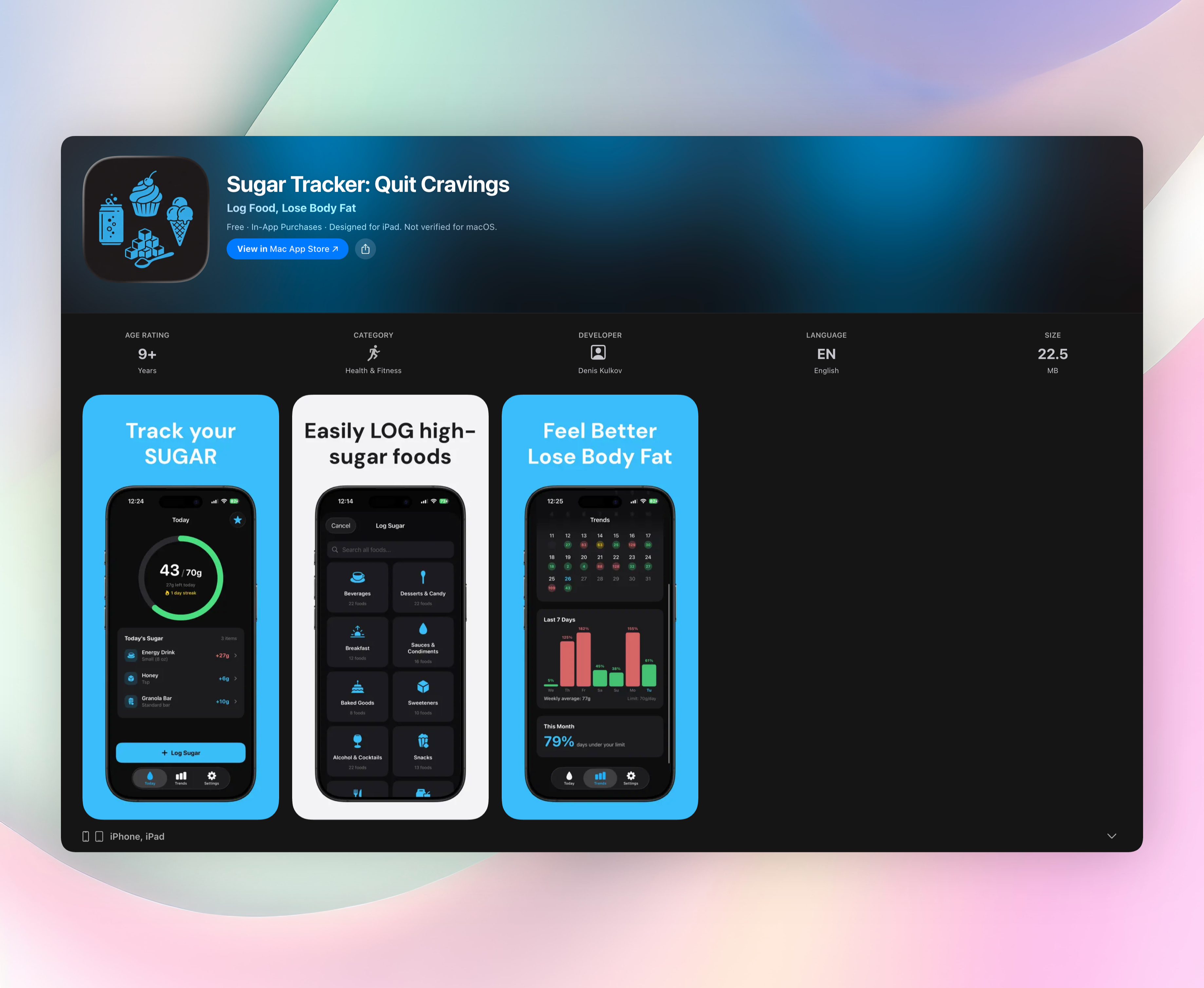
Coming back to a number rather than a vibe is what separates the two outcomes, and the published ceilings give one. The American Heart Association's is 25 g of added sugar a day for women and 36 g for men; WHO's is under 10% of total energy — roughly 50 g on a 2,000-calorie intake — with a conditional suggestion of under 5%. These are population guidelines, not personal prescriptions. Watching the daily number is how drift gets caught while it's still small, which is what Sugar Tracker, an added-sugar tracking app for iPhone, is for.
FAQ
Is fruit allowed on a no sugar diet?
On nearly every version, yes. Whole fruit's sugar arrives with fiber, water, and intact cell structure, and neither WHO nor the AHA counts it as free or added sugar. Fruit juice is the exception — it's grouped with the added sugars even when it's 100% juice.
How long does sugar withdrawal last?
For people who get it, symptoms tend to appear in the first two to three days and fade within the week. Headache, irritability, and cravings are the usual ones. Plenty of people notice very little, and a simultaneous drop in caffeine accounts for part of what others feel.
Can you drink alcohol on a no-sugar month?
Most strict versions cut it. Dry wine and straight spirits carry little or no sugar themselves, but mixers, liqueurs, and cider carry a lot, and alcohol makes holding to any food rule harder. On an ongoing low-sugar approach it's usually treated as a personal call.
Does "no added sugar" mean sugar free?
No. In the US, "sugar free" is a regulated claim meaning under 0.5 g of sugar per serving. "No added sugar" means only that nothing sweet was added during production — the product can still be high in naturally occurring sugar, which is exactly how juice qualifies.
Do stevia and erythritol break a no sugar diet?
Technically no, since neither one is a sugar. Strict sugar detox protocols cut them anyway, arguing that keeping intense sweetness in the diet works against the palate reset. Milder versions allow them. There's no consensus rule either way.
Free Sugar tools
- A1C CalculatorUse this a1c calculator to convert an A1C percentage to estimated average glucose, or enter average glucose to estimate A1C in both common units.
- Banana Carb and Sugar CalculatorFind how many carbs are in a banana by size, quantity and ripeness. Compare total and net carbs, sugar, fibre, calories and carb exchanges.
- Blood Sugar Level ChartEnter a blood glucose reading, unit and test context to see the published range, a chart position and the same value in the other unit.
- Blood Sugar Unit ConverterConvert blood sugar between mg/dL and mmol/L in seconds, with a two-column reference table for common readings.
- Daily Sugar Limit CalculatorEstimate a daily added-sugar limit in grams and teaspoons from your age, sex and calorie target.
- Sugar Cube Grams CalculatorFind how many grams of sugar are in a sugar cube by entering the number of cubes and grams per cube. Get the total sugar and an optional teaspoons equivalent.
- Sugar Grams to Teaspoons ConverterHow many grams is a teaspoon of sugar? A level teaspoon of granulated white sugar weighs about 4.2 g, while nutrition labels round it to 4 g. Convert either way, pick your sugar type, and see how the result compares with the American Heart Association daily added-sugar limits.