
How much sugar in a banana — and in every other common fruit
A medium banana — about 118 grams, peel off — carries roughly 14 grams of sugar and 3 grams of fiber. All of it is naturally occurring, so the added-sugar line on a nutrition label reads 0 g. Whole fruit doesn't count against the daily added-sugar limits from the AHA or WHO.
How much sugar in a banana, by size
Banana sugar scales almost linearly with weight — roughly 12 grams of sugar per 100 grams of fruit:
- Extra small (under 6 inches, ~81 g): about 10 g sugar
- Small (6–7 inches, ~101 g): about 12 g
- Medium (7–8 inches, ~118 g): about 14 g
- Large (8–9 inches, ~136 g): about 17 g
- Extra large (9 inches and up, ~152 g): about 18 g
Ripeness shifts the number more than most people expect. A green banana stores much of its carbohydrate as resistant starch; as it ripens and spots, enzymes convert that starch into free sugars. Total carbohydrate barely moves, but the split does, which is why a speckled banana tastes noticeably sweeter than a firm yellow one of the same weight. Published figures are averages, so treat 14 g as a center point.
How much sugar in fruit, by common serving
Sugar varies several-fold across fruit, and fiber varies more. Approximate values at common serving sizes:
| Fruit | Serving | Sugar | Fiber |
|---|---|---|---|
| Banana | 1 medium (118 g) | 14 g | 3 g |
| Apple, with skin | 1 medium (182 g) | 19 g | 4 g |
| Orange | 1 medium (131 g) | 12 g | 3 g |
| Grapes | 1 cup (151 g) | 23 g | 1 g |
| Mango | 1 cup sliced (165 g) | 23 g | 3 g |
| Blueberries | 1 cup (148 g) | 15 g | 4 g |
| Strawberries | 1 cup halved (152 g) | 7 g | 3 g |
| Raspberries | 1 cup (123 g) | 5 g | 8 g |
| Watermelon | 1 cup diced (152 g) | 9 g | <1 g |
| Raisins | ¼ cup (~40 g) | 24 g | 1.5 g |
| Medjool dates | 2 dates (48 g) | 32 g | 3 g |
| Orange juice | 1 cup (8 oz) | 21 g | <1 g |
Berries sit at the low end because they are mostly water and skin — raspberries deliver more fiber than sugar, which almost nothing else in the produce aisle does. Drying removes water, not sugar: a quarter cup of raisins carries about as much sugar as a full cup of grapes, in a handful you can eat in twenty seconds.
Why 14 grams from a banana isn't 14 grams from a candy bar
Fructose and glucose from fruit are the same molecules as in a cookie. What differs is the delivery.
Fiber and cell structure. Fruit sugar sits inside intact plant cells surrounded by pectin and cellulose. Your gut has to break that matrix down before the sugar reaches the bloodstream, which flattens the rise. A candy bar hands over sucrose with nothing slowing it.
Water and volume. A cup of watermelon is 9 g of sugar packed into 152 g of mostly water. A 12-ounce cola is about 39 g in a container you can finish standing at the fridge.
Eating rate. Chewing takes time — enough for fullness signals to register. Liquid sugar skips the step.
What rides along. The banana also brings potassium, vitamin B6, and polyphenols. The candy bar brings sugar and fat.
That's an argument about packaging, not chemistry — juice it, dry it, or cook it into syrup, and the advantage shrinks fast.
Does fruit count as added sugar?
Whole fruit does not. The FDA defines added sugars as sugars added during processing or packaging, plus sugars from syrups, honey, and concentrated fruit or vegetable juice beyond what the same volume of 100% juice would supply. A banana contains none of those, so its Nutrition Facts panel shows total sugars with 0 g added. The AHA guideline (no more than about 25 g of added sugar a day for most women and 36 g for most men) and the WHO free-sugars guideline (under 10% of daily calories, with a conditional suggestion of under 5%) are both written to exclude the sugars in intact fruit. For the difference between the two lines on the panel, see added sugar vs natural sugar and this walkthrough of reading a nutrition label.
The two frameworks disagree about juice. WHO counts 100% fruit juice as a free sugar; US labeling does not list it as added sugar. So the same glass of orange juice spends part of your allowance under one guideline and none of it under the other.
The four places fruit crosses the line
Fruit juice. Even unsweetened, juice removes the fiber and the chewing. One cup of orange juice takes about three oranges' worth of sugar and delivers it in a few swallows.
Sweetened dried fruit. Dried cranberries are almost always sweetened, and dried mango, pineapple, and banana chips often are. Check the ingredient list for cane sugar, apple juice concentrate, or "fruit juice sweetened" — those are added sugars by FDA definition even when the source is fruit.
Canned fruit in heavy or light syrup. The syrup is added sugar, straightforwardly. Packed "in juice" or "in water" is not.
Smoothies. A drink built from a banana, a cup of mango, and a cup of grapes lands near 60 g of sugar before any honey, yogurt, or juice base goes in — three servings of fruit that no one would eat whole in one sitting.
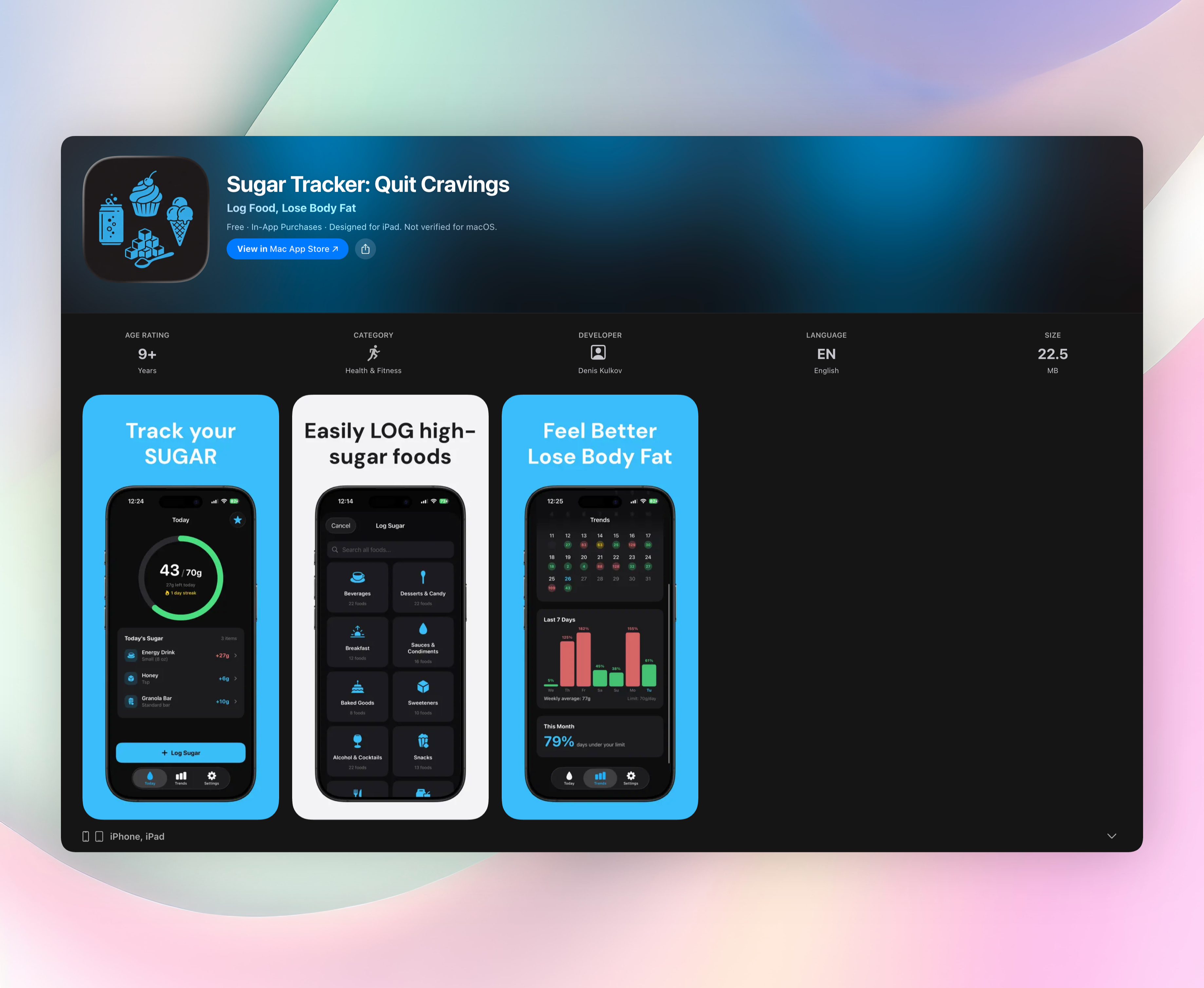
Of those four, juice is the one that stays genuinely contested — a free sugar under WHO's rules, not an added sugar under the FDA's. If you'd rather see that distinction as a number than as a debate, Sugar Tracker is an added-sugar tracking app for iPhone — the glass of juice registers against the added-sugar total while the whole banana leaves it unchanged.
How much sugar per day from fruit is reasonable
The US Dietary Guidelines put fruit intake at about 2 cups a day for a 2,000-calorie pattern, and recommend whole fruit over juice for most of those choices. Two cups of mixed whole fruit generally lands somewhere between 25 and 45 grams of natural sugar, depending on whether you lean toward berries or toward grapes and mango.
None of that counts against the daily added-sugar limit in the AHA or WHO guidance. The published guidelines set a floor for fruit, not a ceiling — the caps apply to what gets added during processing. People managing diabetes or another condition often work to different targets set with a clinician.
FAQ
Is fruit sugar bad for you?
Not in whole fruit, according to the way the major guidelines are written — WHO and the AHA both exclude it from their sugar limits, and dietary patterns high in whole fruit are consistently recommended. The concern applies to the concentrated forms: juice, sweetened dried fruit, and syrup-packed canned fruit.
How much sugar is in a banana compared to an apple?
A medium banana has about 14 g of sugar; a medium apple with skin has about 19 g. The apple also carries more fiber, roughly 4 g to the banana's 3 g. Per 100 grams the two are closer than whole-fruit comparisons suggest — the apple is simply bigger.
Do bananas have more sugar than most fruit?
Per 100 grams, bananas sit in the upper-middle range: more than berries or watermelon, less than grapes, cherries, or any dried fruit. Their reputation comes from density: a banana holds far less water per bite than a berry or a melon slice, so the same mouthful carries more sugar.
Does a green banana have less sugar?
Yes. Unripe bananas hold more of their carbohydrate as resistant starch, which the small intestine doesn't fully digest. Ripening converts that starch to sugar, so a spotted banana lists more sugar than a green one of equal weight even though total carbohydrate is close to unchanged.
Free Sugar tools
- A1C CalculatorUse this a1c calculator to convert an A1C percentage to estimated average glucose, or enter average glucose to estimate A1C in both common units.
- Banana Carb and Sugar CalculatorFind how many carbs are in a banana by size, quantity and ripeness. Compare total and net carbs, sugar, fibre, calories and carb exchanges.
- Blood Sugar Level ChartEnter a blood glucose reading, unit and test context to see the published range, a chart position and the same value in the other unit.
- Blood Sugar Unit ConverterConvert blood sugar between mg/dL and mmol/L in seconds, with a two-column reference table for common readings.
- Daily Sugar Limit CalculatorEstimate a daily added-sugar limit in grams and teaspoons from your age, sex and calorie target.
- Sugar Cube Grams CalculatorFind how many grams of sugar are in a sugar cube by entering the number of cubes and grams per cube. Get the total sugar and an optional teaspoons equivalent.
- Sugar Grams to Teaspoons ConverterHow many grams is a teaspoon of sugar? A level teaspoon of granulated white sugar weighs about 4.2 g, while nutrition labels round it to 4 g. Convert either way, pick your sugar type, and see how the result compares with the American Heart Association daily added-sugar limits.