
How to stop eating sugar: a four-week staged plan
Cut added sugar in stages, not all at once. Log one ordinary week to get a baseline number, then remove a single source each week — drinks, then sauces, then breakfast, then treats. Each stage takes out roughly a third of what's left.
How to stop eating sugar without going cold turkey
Most advice on how to quit sugar assumes a detox: eight things change on the same Monday. When the headache and the short temper arrive on Wednesday, there's no telling which change caused it, and the plan is gone by Friday.
A staged taper changes one category a week, so each week has exactly one thing to get used to and last week's swap becomes the default before the next lands. The order below runs from the biggest added-sugar source in a typical American diet down to the smallest.
| Stage | What changes | Typical added sugar removed |
|---|---|---|
| Week 1 | Sweetened drinks — soda, sweet coffee, juice blends, energy drinks | 20–40 g/day |
| Week 2 | Condiments, sauces, dressings, marinades | 5–15 g/day |
| Week 3 | Breakfast — cereal, flavored yogurt, granola, sweet spreads | 10–25 g/day |
| Week 4 | Desserts and snack sweets, moved onto a schedule | 5–15 g/day |
Those ranges depend on where you start, which is why the plan opens with a measurement week.
Week 0: get a baseline before you cut anything
Skip this and you're guessing. A swap only pays off if it hits something you eat often, so log everything for seven days, weekend included — weekends usually run higher.
You want two numbers out of that week: your average daily added sugar in grams, and the four or five items supplying most of it. US Nutrition Facts panels have carried an "Includes Xg Added Sugars" line since 2020–2021, so the number is printed rather than inferred — though it helps to know how to read the rest of the label and to check the serving size against what you pour.
To track sugar intake without turning it into a second job, log by repeat item rather than by meal — most people rotate the same eight or ten breakfasts and drinks. Sugar Tracker is an added-sugar tracking app for iPhone.
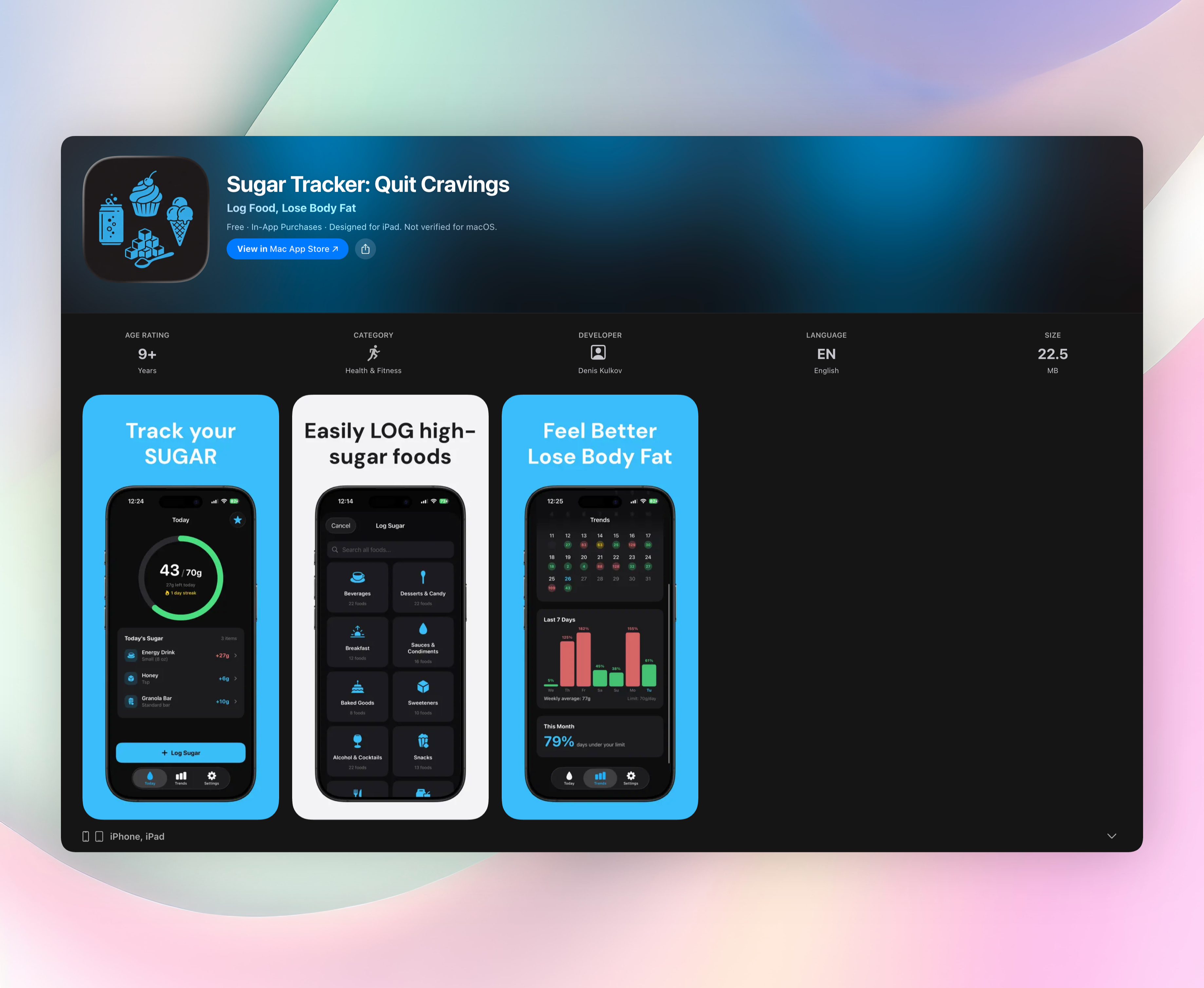
The total is almost never spread evenly. A few repeat items carry the bulk of it — not the birthday cake you eat twice a year — and those are what the next four weeks target.
The four-week taper
Week 1: drinks
Beverages are the largest single source of added sugars in the American diet, and the easiest to cut because nothing about the meal changes. A 12 oz can of regular cola carries about 39 grams of added sugar — past the American Heart Association's full-day limit for either sex, and a large flavored coffee drink can land in the same range.
Don't go to zero if you're drinking four sodas a day. Go to two this week, one the next. Sparkling water, unsweetened iced tea, coffee with half the syrup pumps, or juice cut with water all work as landing spots. Zero-calorie sweetened drinks remove the sugar and the calories; whether they help long-term intake is still argued over, so treat them as a bridge rather than the destination.
Week 2: sauces, condiments, and dressings
This is the stage people skip and the reason their totals stall. A tablespoon of ketchup runs about 4 grams of sugar. Barbecue sauce, teriyaki, and most bottled honey-mustard dressings run several times that per labeled serving — and the labeled serving is smaller than what ends up on the plate.
Nothing here requires cooking differently. Mustard, hot sauce, vinegar, olive oil, and salsa are near-zero on added sugar. Swap the two bottles you reach for most and leave the rest alone.
Week 3: breakfast
Breakfast is where added sugar hides behind a health halo. Flavored yogurt commonly carries 10–17 grams of added sugar per cup, granola 6–12 grams per half-cup, and sweetened cereals land in the same band. Plain yogurt still shows sugar on the label — that's lactose, which isn't added sugar and isn't what you're cutting.
The swaps are unglamorous and they hold: plain yogurt with fruit you cut yourself, oats instead of instant flavored packets, eggs, or fruit with an unsweetened nut butter.
Week 4: treats
The last stage isn't elimination. Give dessert a schedule — two named days a week, eaten sitting down — instead of leaving it available every evening. A scheduled treat is one decision a week; an available one is a decision every night, and the nightly version wrecks a total.
By now you've cut back on sugar in four separate places without a day of white-knuckling.
Why a taper sticks when quitting cold turkey doesn't
Two things happen over four weeks that can't happen over four days. The first is that the rough patch stays small. There's no formally recognized sugar-withdrawal syndrome in humans, but plenty of people report headaches, irritability, and flat mood in the first days of a sharp cut. Removing 30 grams a week is a milder version of that than removing 75 at once, and it arrives one week at a time. If cravings are the part that beats you, the tactics for handling sugar cravings matter more than willpower.
The second is palate adaptation. Sweetness preference is trained by exposure and drifts down when exposure drops. After two or three weeks at a lower level, the flavored yogurt you used to eat daily tends to read as cloying. That shift is what makes the cut permanent: you stop wanting the food instead of resisting it. Cold turkey rarely lasts long enough to get there.
How much sugar per day should you actually aim for
The published limits are narrower than most people expect:
- American Heart Association: no more than 25 g (6 teaspoons) of added sugar a day for women and 36 g (9 teaspoons) for men.
- World Health Organization: free sugars below 10% of total energy, with a conditional recommendation below 5% — roughly 50 g and 25 g on a 2,000-calorie day. Free sugars include honey, syrups, and fruit juice, but not the sugar inside whole fruit.
- Dietary Guidelines for Americans: under 10% of daily calories from added sugars for everyone aged two and up.
These are population guidelines, not personal prescriptions; if a doctor has given you a different number, that one wins. If your baseline came back at 75 grams, treat 25 as the direction rather than the week-four deadline — halving the baseline in month one is a real result, and the gram-level targets can wait until you've held the halfway mark.
Most people asking how much sugar per day for weight loss are looking for a separate, lower number. The guidelines don't publish one. Sugar carries 4 calories per gram, so dropping 50 grams a day removes about 200 calories — meaningful only if something else doesn't quietly replace them.
FAQ
How long does it take to stop craving sugar?
The sharpest cravings tend to fade within the first week or two of a cut, and the taste shift — when previously normal foods start reading as too sweet — is commonly reported around two to three weeks in. Tapering spreads that adjustment across four weeks and makes each step milder.
Is it better to quit sugar cold turkey or gradually?
Both reach the same endpoint; gradual has the better completion rate because each week asks for one change instead of eight. If you already know half measures don't work for you, cold turkey is a legitimate choice — do the baseline week first either way, so you know what you removed.
Do I have to give up fruit?
No. The guidelines target added and free sugars, and whole fruit is neither. Fruit juice is a different case: WHO counts it as a free sugar because the sugar is freed from the fruit's structure, which is why juice sits in the week-one drinks stage.
What's the best way to reduce sugar intake when I eat out?
Drinks and sauces carry most of it, and both are orderable. Water or unsweetened tea instead of soda, dressing and sauce on the side, and skipping the glazed or teriyaki option covers most of a restaurant meal's added sugar.
Free Sugar tools
- A1C CalculatorUse this a1c calculator to convert an A1C percentage to estimated average glucose, or enter average glucose to estimate A1C in both common units.
- Banana Carb and Sugar CalculatorFind how many carbs are in a banana by size, quantity and ripeness. Compare total and net carbs, sugar, fibre, calories and carb exchanges.
- Blood Sugar Level ChartEnter a blood glucose reading, unit and test context to see the published range, a chart position and the same value in the other unit.
- Blood Sugar Unit ConverterConvert blood sugar between mg/dL and mmol/L in seconds, with a two-column reference table for common readings.
- Daily Sugar Limit CalculatorEstimate a daily added-sugar limit in grams and teaspoons from your age, sex and calorie target.
- Sugar Cube Grams CalculatorFind how many grams of sugar are in a sugar cube by entering the number of cubes and grams per cube. Get the total sugar and an optional teaspoons equivalent.
- Sugar Grams to Teaspoons ConverterHow many grams is a teaspoon of sugar? A level teaspoon of granulated white sugar weighs about 4.2 g, while nutrition labels round it to 4 g. Convert either way, pick your sugar type, and see how the result compares with the American Heart Association daily added-sugar limits.