
Low sugar snacks, organized by when you're actually snacking
Low sugar snacks carry under about 5 grams of added sugar per serving. Whole foods mostly qualify — nuts, plain yogurt, cheese, eggs, unglazed jerky, fresh fruit. Packaged snacks sold as healthy mostly don't; the grams hide between the front of the box and the Nutrition Facts panel.
What counts as a low sugar snack
Added sugar is what gets put in during processing. It sits on its own line under Total Sugars on the Nutrition Facts panel, with a %DV based on a 50 g Daily Value. The American Heart Association suggests roughly 25 g a day for women and 36 g for men; the World Health Organization holds free sugars under 10% of daily calories, with a further conditional reduction below 5%. Both are published population guidance, not personal advice — see how many grams of sugar per day those numbers translate to.
A workable per-snack threshold is 5 g of added sugar or less — 10% DV on the label. The FDA calls 5% DV or less low and 20% or more high, so a bar with 10 g of added sugar already reads high by the label's own standard.
Lactose in plain yogurt and fructose in a banana count toward total sugars but not added sugars, which is why a snack can read 12 g of sugar with nothing added to it. That distinction does most of the work here — see added sugar vs natural sugar for more.
Low sugar snacks for the desk
Desk snacking fails on volume, so protein and fat matter as much as the sugar line. These all sit at or near zero added sugar:
- Almonds or pistachios, 1 oz — 1–2 g of natural sugar, none added.
- Plain Greek yogurt, 5.3 oz cup — roughly 5–6 g, all lactose, plus 15–17 g protein.
- Cottage cheese, ½ cup — 3–4 g lactose, 12–14 g protein.
- Two hard-boiled eggs — 0 g.
- String cheese — under 1 g.
- Air-popped popcorn, 3 cups — 0 g, around 90 calories.
The foods with no added sugar by definition never need a label check: eggs, plain nuts, plain dairy, meat, fish, vegetables, fresh fruit. Everything in a wrapper does.
Post-workout snacks
Chocolate milk runs roughly 20–24 g of total sugar per cup, about half of it added — a lot for something framed as recovery. Alternatives that still deliver protein: Greek yogurt with berries, cottage cheese, or a ready-to-drink protein shake, though those vary wildly — many land at 0–2 g of sugar and some at 15.
Protein bars deserve their own warning: the category runs from about 1 g of added sugar to 20 g, and the ones that taste like candy sit at the top of that range. Marketing on protein or fiber says nothing about the sugar line.
Evening snacks for a sweet tooth
Healthy snacks for sugar cravings work best when they deliver the sensory part without the load:
- Frozen grapes or blueberries — the fruit's own sugar, and the cold slows eating down.
- Plain Greek yogurt with berries, cinnamon, and a drop of vanilla extract — under 8 g total, none added.
- A 10 g square of 85% dark chocolate runs 1–2 g of sugar; the same size at 70% closer to 2–3 g.
- Cinnamon herbal tea, sweet-tasting with no sugar at all.
Travel and airport snacks
Airport shelves are largely sugar in disguise. Sweetened dried cranberries carry something like 25 g of sugar per quarter cup, nearly all of it added, since raw cranberries are too tart to sell — which turns standard trail mix into dessert.
What travels well: plain nuts, a meat stick at 0–1 g, whole fruit, wrapped cheese, plain popcorn. Jerky needs checking — "original" flavors often carry 4–8 g per ounce, teriyaki more.
The traps, and what to swap in
How much sugar in granola bars is the question that reorders most people's pantry. Most chewy bars land between 6 and 12 g of added sugar, and coated or dessert-flavored versions go higher. That's a quarter to half of the AHA's suggested daily figure for women.
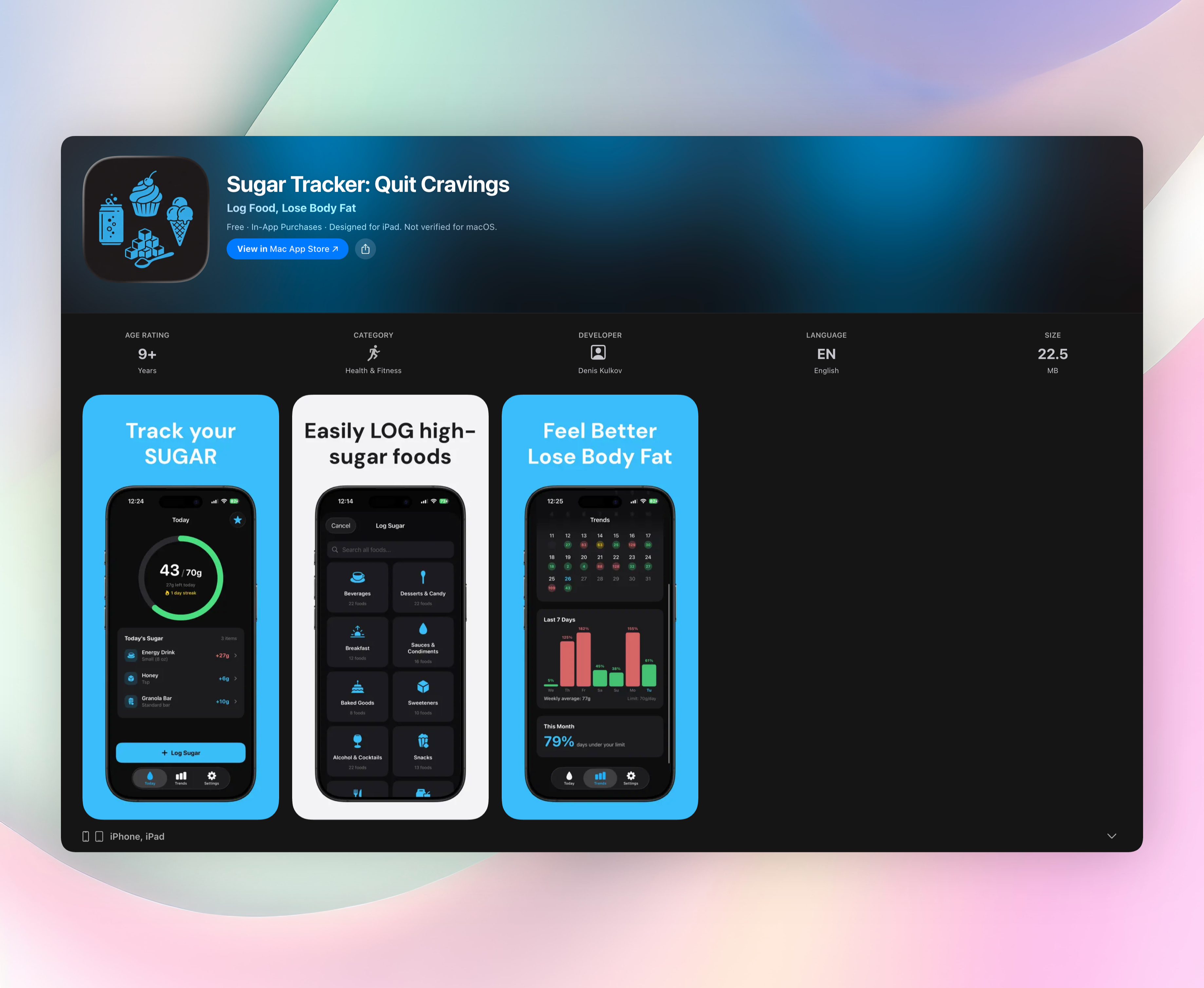
Seeing the running total before the next snack is what makes the swap an actual decision rather than a later regret — Sugar Tracker, an added-sugar tracking app for iPhone, keeps that number in view, so an 11 g bar gets weighed against what the day already holds.
| Snack trap | Typical added sugar | Swap | Typical added sugar |
|---|---|---|---|
| Chewy granola bar | 6–12 g | Almonds plus a square of dark chocolate | 0–2 g |
| Flavored yogurt cup, 5.3 oz | 8–15 g | Plain Greek yogurt with fresh berries | 0 g |
| Sweetened dried-fruit trail mix, ¼ cup | 15–25 g | Plain nuts with unsweetened coconut chips | 0 g |
| Flavored instant oatmeal packet | 8–12 g | Plain oats with cinnamon and berries | 0 g |
| Sweetened protein bar | 8–20 g | Cottage cheese or a low-sugar shake | 0–2 g |
| Glazed or teriyaki jerky, 1 oz | 4–8 g | Plain meat stick | 0–1 g |
That oatmeal row doubles as one of the simplest low sugar breakfast ideas going. Plain oats lose nothing once cinnamon and fruit are in, and the swap drops 8–12 g off the day before 9 a.m.
How to tell a genuinely low-sugar package from one that says so
- Ignore the front. "Made with real fruit," "wholesome," and "naturally sweetened" are marketing copy, not definitions.
- Know which claims are regulated. "Sugar free" means under 0.5 g per serving; "reduced sugar" means only 25% less than the standard version, which can still be a lot; "no sugar added" means none was added, though a no-sugar-added dried mango still carries the fruit's own.
- Read the Added Sugars line and its %DV. 5% or less is low; 20% or more is high.
- Check the serving size — a bar secretly holding two servings doubles every number on the panel.
- Scan the ingredients for aliases — cane juice, brown rice syrup, agave nectar, honey, molasses, dextrose, fruit juice concentrate. Several spread down the list can outweigh one sweetener near the top. Maltodextrin isn't counted as a sugar on the label at all, though it behaves like a fast carb.
- Expect sweeteners in anything sugar free. Most of a sugar free snacks list is built on sugar alcohols such as erythritol, maltitol, and xylitol, or non-nutritive sweeteners; maltitol especially draws digestive complaints in quantity. See how to read a nutrition label for the rest of the panel.
FAQ
How much sugar is in peanut butter?
Two tablespoons of conventional peanut butter carry about 3 g of total sugar, roughly 2 g of it added. Natural peanut butter — just peanuts and salt — runs closer to 1–1.5 g, all from the peanuts. Reduced-fat versions often carry more added sugar than the regular kind, since something has to replace the fat.
How much sugar is in granola bars?
Most chewy granola bars carry 6–12 g of added sugar each, and yogurt-coated or dessert-flavored versions climb past that. A bar sold on its protein or fiber content isn't automatically lower.
Is fruit a low sugar snack?
Whole fruit has no added sugar, so it clears the threshold by definition. A medium banana holds about 14 g of natural sugar, a medium apple around 19 g, and a cup of raspberries closer to 5 g. Dried fruit concentrates that into a much smaller volume, and many dried products are sweetened on top of it.
What can I snack on at night instead of dessert?
Frozen berries or grapes, plain Greek yogurt with cinnamon, a square of 85% dark chocolate, or cottage cheese with cocoa all hit the same notes for a few grams — cold or intensely flavored, in a small portion, rather than sweet in volume.
Does "no sugar added" mean low sugar?
No — it only means no sugar was added during processing; the food's own sugars still count under Total Sugars. Dried mango, fruit juice, and 100% fruit purees can carry 20 g or more per serving and still wear that label.
Free Sugar tools
- A1C CalculatorUse this a1c calculator to convert an A1C percentage to estimated average glucose, or enter average glucose to estimate A1C in both common units.
- Banana Carb and Sugar CalculatorFind how many carbs are in a banana by size, quantity and ripeness. Compare total and net carbs, sugar, fibre, calories and carb exchanges.
- Blood Sugar Level ChartEnter a blood glucose reading, unit and test context to see the published range, a chart position and the same value in the other unit.
- Blood Sugar Unit ConverterConvert blood sugar between mg/dL and mmol/L in seconds, with a two-column reference table for common readings.
- Daily Sugar Limit CalculatorEstimate a daily added-sugar limit in grams and teaspoons from your age, sex and calorie target.
- Sugar Cube Grams CalculatorFind how many grams of sugar are in a sugar cube by entering the number of cubes and grams per cube. Get the total sugar and an optional teaspoons equivalent.
- Sugar Grams to Teaspoons ConverterHow many grams is a teaspoon of sugar? A level teaspoon of granulated white sugar weighs about 4.2 g, while nutrition labels round it to 4 g. Convert either way, pick your sugar type, and see how the result compares with the American Heart Association daily added-sugar limits.