How to stop sugar cravings (and what's really causing them)
Sugar cravings usually have a physical trigger, not a willpower problem. Learning how to stop sugar cravings means fixing what comes before them — a low-protein breakfast, a short night — and having a plan for the ones already underway. Most trace back to four things: glucose swings, under-eating, short sleep, and habit cues.
Why do I crave sugar in the first place?
A craving is not hunger. Hunger is general and patient: any food will do. A craving is specific and urgent — not "food," but that cookie, right now. The specificity is the tell: a learned response sitting on a physical signal.
The physical signal is usually one of these:
- A falling glucose curve. Refined carbohydrate raises blood glucose fast, insulin brings it down, and the descent registers as an emergency.
- Too little protein, fat, or fiber at the last meal. They slow gastric emptying and blunt the rise-and-fall; without them, a meal leaves you hungry ninety minutes later.
- An overall energy deficit. Eating almost nothing until 4 p.m. isn't discipline; it's a debt collected after dark, with interest.
- Short sleep. A run of short nights shifts appetite signaling — ghrelin up, leptin down — and pushes intake toward fast carbohydrate.
- Stress. Cortisol raises appetite for energy-dense food, and sweet food interrupts a bad mood for a few minutes. The effect is real, which is why the habit sticks.
- Thirst. Mild dehydration gets misread as appetite often enough that water is worth trying first.
The learned part is the cue: 3 p.m. at your desk, the drive home, the first ten minutes on the couch. Cues fire because the same thing happened in the same place a hundred times — hungry or not.
The 3 p.m. craving usually started at breakfast
Of all the causes of sugar cravings, this is the one people miss, because cause and symptom sit six hours apart.
A breakfast of refined carbohydrate and little else — pastry, most cereals, juice, toast with jam — produces a quick glucose rise and a matching insulin response. Two to three hours later the curve can land back at or below where it started, and the body's answer to a falling curve is an urgent interest in sugar. The pastry at 9 a.m. writes the craving at 3 p.m.
The fix is structural, not motivational: 25–30 grams of protein in the first meal — eggs, Greek yogurt, cottage cheese — plus fat or fiber. Same calories, different shape of day.
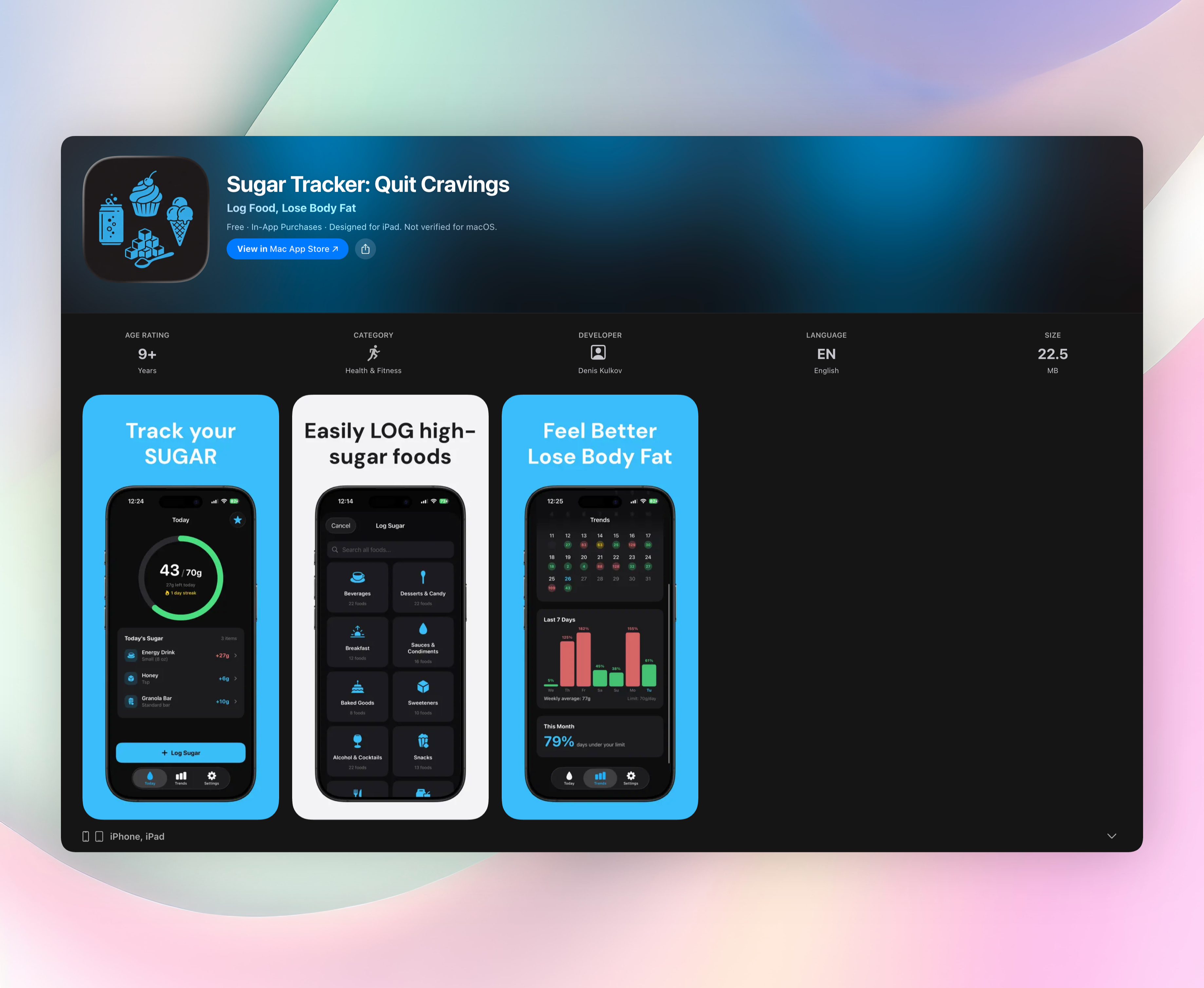
Seeing the pattern beats arguing with it. Sugar Tracker, an added-sugar tracking app for iPhone, earns its keep for a week here: with the morning's added-sugar grams written down next to the hour the craving hit, the culprit stops being a mystery.
Why do I crave sugar after eating?
Two things, usually. The meal may have been mostly carbohydrate, producing a rise and fall rather than a plateau — you're not unfed, you're two hours into a curve. The other is conditioning: if dinner has ended with something sweet for years, the plate hitting the sink is the cue. Alcohol contributes on both counts.
What deficiency causes sugar cravings?
The popular answer is magnesium, sometimes chromium or zinc. The evidence is thinner than the confidence behind it.
Magnesium deficiency is real and low intake is common, but its recognized signs are neuromuscular — cramps, tremor, weakness — not a pull toward sweets. Chromium has been studied in small trials on carbohydrate craving and glucose handling, with inconsistent results across varied doses and populations. Neither has an established mechanism that explains a 3 p.m. craving in someone who ate a pastry for breakfast.
One deficiency does cause a mechanical craving, though not for sugar: iron deficiency is associated with pica — most recognizably pagophagia, a compulsion to chew ice.
Chase the boring explanations first: sleep, protein, total intake, meal timing. Cravings that persist after those are fixed, especially alongside other symptoms, are worth raising with a clinician rather than a supplement aisle.
Sugar cravings at night behave differently
Night cravings are rarely glucose dips. Three drivers dominate.
The daytime deficit. Coffee for breakfast, a small lunch, nothing at 4 p.m. The body settles the account after dark, and asks for the fastest energy going.
Sleep pressure and late screens. Staying up adds waking hours in a window when appetite favors eating, and starts tomorrow with the sleep debt that raises tomorrow's cravings.
The cue. The couch, the streaming app, the specific chair. For most people the evening craving is a place and a routine before it's a nutrient.
The countermeasures match: move calories earlier so dinner isn't carrying the day, build dinner around protein and fiber, decide what evening food looks like before sitting down, and store the trigger food where reaching it takes a decision. Stocking easy alternatives beats resolve — this list of low sugar snacks needs no prep.
Match the fix to the trigger
| Craving pattern | Likely driver | What actually helps |
|---|---|---|
| Mid-afternoon, hours after a carb-heavy breakfast | Falling glucose curve | Protein and fat at breakfast; a real lunch |
| Right after finishing a meal | Conditioned "sweet finish"; low-protein meal | Change the after-meal routine; add protein |
| Evening on the couch, not hungry earlier | Habit cue plus daytime under-eating | Redistribute calories earlier; break the cue |
Foods for sugar cravings that actually help
Protein first. Twenty to thirty grams — Greek yogurt, cottage cheese, eggs, tuna, edamame — does more for an active craving than anything sweet-but-virtuous, because it answers the signal, not the flavor.
Fiber and water add volume without much energy, which is why an apple with peanut butter outperforms a rice cake. Whole fruit is a fair answer to a real want for sweetness: its sugar arrives with fiber, water, and chewing time, which is why guidance treats it differently from added sugar (added sugar vs natural sugar covers the distinction).
Published guidelines set the reference points: the American Heart Association suggests a limit of 25 g of added sugar a day for women and 36 g for men, while the World Health Organization recommends free sugars under 10% of energy intake, with a conditional further reduction to 5% — how many grams of sugar per day breaks them down.
Total bans tend to backfire: deprivation raises the food's salience, so a planned, portioned dessert beats an outright ban most people can't sustain.
How to stop sugar cravings in the moment
- Wait ten minutes, in a different room. Most cravings peak and fade within ten to twenty minutes if they're neither fed nor fought.
- Drink water or unsweetened tea first. Cheap to test, sometimes the whole answer.
- Eat protein if it's been over four hours. A craving on an empty stomach is a hunger signal in costume.
- Take a short walk. Movement blunts the stress version and puts distance between you and the cue.
- If it survives all that, eat it deliberately. On a plate, portioned, sitting down. A decided-on cookie ends the loop; one eaten standing at the counter after a fight starts the next one.
FAQ
How long do sugar cravings last when you cut back?
An individual craving usually peaks and fades within ten to twenty minutes, whether or not you act on it. Frequency is the longer project: as cues stop being reinforced and meals stop producing sharp glucose swings, the daily pull eases over weeks, not days.
What deficiency causes sugar cravings?
Usually none. Magnesium, chromium, and zinc get blamed, but the evidence tying them to a pull toward sweets is weak, and their recognized deficiency signs look different. Iron deficiency is linked to pica — often a craving for ice — not sugar.
Does drinking water stop sugar cravings?
Sometimes, and it costs nothing to check. Mild dehydration can register as vague appetite, and a glass of water buys a few minutes of delay. If the craving survives that, it wasn't thirst.
Why do I crave sugar at night when I'm fine all morning?
Two reasons stack. Mornings run on coffee and momentum; the evening carries whatever the day under-delivered. The couch, the screen, and the hour are also a heavily reinforced cue, and cues fire independent of hunger.
Free Sugar tools
- A1C CalculatorUse this a1c calculator to convert an A1C percentage to estimated average glucose, or enter average glucose to estimate A1C in both common units.
- Banana Carb and Sugar CalculatorFind how many carbs are in a banana by size, quantity and ripeness. Compare total and net carbs, sugar, fibre, calories and carb exchanges.
- Blood Sugar Level ChartEnter a blood glucose reading, unit and test context to see the published range, a chart position and the same value in the other unit.
- Blood Sugar Unit ConverterConvert blood sugar between mg/dL and mmol/L in seconds, with a two-column reference table for common readings.
- Daily Sugar Limit CalculatorEstimate a daily added-sugar limit in grams and teaspoons from your age, sex and calorie target.
- Sugar Cube Grams CalculatorFind how many grams of sugar are in a sugar cube by entering the number of cubes and grams per cube. Get the total sugar and an optional teaspoons equivalent.
- Sugar Grams to Teaspoons ConverterHow many grams is a teaspoon of sugar? A level teaspoon of granulated white sugar weighs about 4.2 g, while nutrition labels round it to 4 g. Convert either way, pick your sugar type, and see how the result compares with the American Heart Association daily added-sugar limits.