How much sugar in a can of Coke — and in other everyday drinks
A 12 oz can of Coca-Cola Classic has 39 grams of sugar — about 9¼ teaspoons. That's more than the American Heart Association's entire daily added-sugar guideline for women (25 g) and most of the men's guideline (36 g). A 20 oz bottle holds 65 g.
How much sugar in a can of Coke, and in the rest of the soda aisle
The 39 g figure is for US Coca-Cola Classic, sweetened with high-fructose corn syrup; cane-sugar and reduced-sugar versions sold in other markets land at different gram counts, so the can in front of you beats a number copied from another country's label.
Across the aisle the spread is narrower than expected: mainstream colas and lemon-limes cluster between 38 and 41 g per 12 oz can, while citrus sodas like Mountain Dew sit higher, around 46 g. The sugar content of drinks in the cooler is set more by container size than by which logo is on it.
One level teaspoon of granulated sugar weighs roughly 4.2 g. That's the conversion behind every teaspoon figure below.
| Drink | Serving | Sugar | Teaspoons | % of 25 g | % of 36 g |
|---|---|---|---|---|---|
| Coca-Cola Classic | 12 oz can | 39 g | 9¼ | 156% | 108% |
| Coca-Cola Classic | 20 oz bottle | 65 g | 15½ | 260% | 181% |
| Pepsi | 12 oz can | 41 g | 9¾ | 164% | 114% |
| Dr Pepper | 12 oz can | 40 g | 9½ | 160% | 111% |
| Sprite | 12 oz can | 38 g | 9 | 152% | 106% |
| Mountain Dew | 12 oz can | 46 g | 11 | 184% | 128% |
| Monster Energy | 16 oz can | 54 g | 12¾ | 216% | 150% |
| Red Bull | 8.4 oz can | 27 g | 6½ | 108% | 75% |
| Bottled sweet tea | 12 oz | 24–30 g | 6–7 | 96–120% | 67–83% |
| Gatorade Thirst Quencher | 12 oz | 21 g | 5 | 84% | 58% |
| Gatorade Thirst Quencher | 20 oz bottle | 34 g | 8 | 136% | 94% |
| 100% orange juice | 8 oz cup | 21 g (natural) | 5 | not added sugar | not added sugar |
| Dry red or white wine | 5 oz glass | ~1 g | ¼ | ~4% | ~3% |
| Diet soda, sparkling water | any | 0 g | 0 | 0% | 0% |
Percentages are measured against the AHA added-sugar guidelines; juice and wine sugars are shown for scale, not scored the same way.
The daily limits these grams are measured against
Two published guidelines frame these numbers. The American Heart Association suggests no more than 25 g (6 teaspoons) of added sugar a day for women and 36 g (9 teaspoons) for men. The World Health Organization works in free sugars — added sugars plus the sugars in honey, syrups, and fruit juice — recommending under 10% of daily energy, with a conditional target under 5%, about 25 g on a 2,000-calorie diet. More on where these numbers come from: how many grams of sugar per day.
The Nutrition Facts panel uses neither. Its %DV for Added Sugars is built on a 50 g Daily Value, so a 12 oz Coke prints 78% DV — accurate to the label, but roughly half the burden the AHA figure implies. That gap is why a package can look tamer than it is; how to read a nutrition label covers the rest of the panel.
How much sugar in soda depends on the container, not the brand
A 20 oz bottle of regular soda carries about 65 g of sugar — 15½ teaspoons, more than two and a half days of the women's guideline in one container. Fountain cups, even with ice, usually pour more than that.
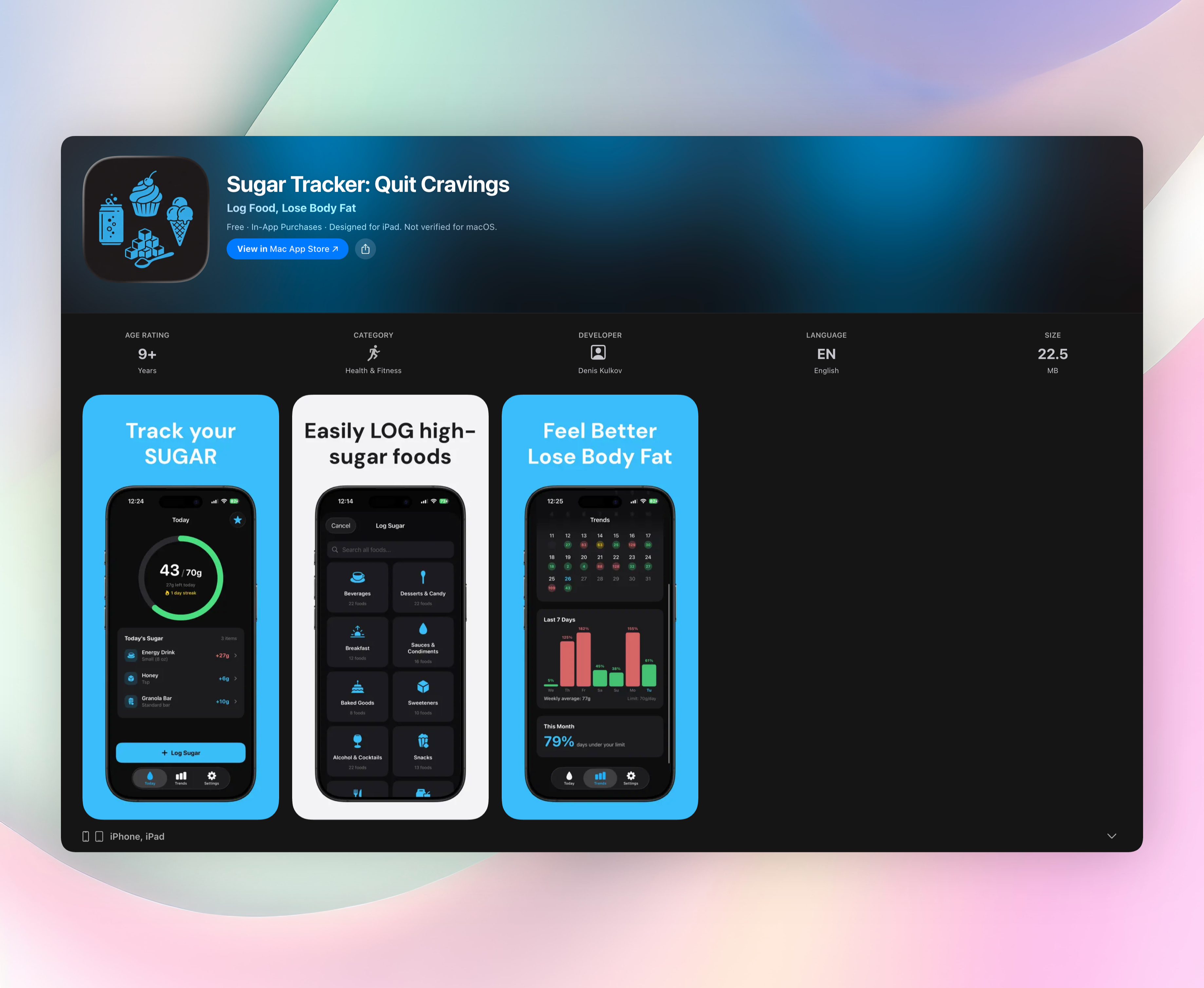
That bottle often arrives before any of the day's food does, which makes it easy to underestimate. Logging it in Sugar Tracker, an added-sugar tracking app for iPhone, before lunch shows exactly how little allowance is left for the rest of the day.
The 7.5 oz mini can, at the other end, holds about 25 g. Same syrup, same taste, roughly a third of the sugar in the bottle.
How much sugar in Gatorade and other sports drinks
Gatorade Thirst Quencher runs about 21 g of sugar per 12 oz — half a soda — but it rarely comes in a 12 oz serving. The standard 20 oz bottle is closer to 34 g, and a 28 oz bottle lands near 49 g, back in soda territory.
That sugar is doing a job: sports drinks are a dilute carbohydrate-electrolyte solution built for hot or prolonged exertion, not for sitting at a desk. Zero-sugar versions keep the electrolytes and drop the carbohydrate.
Sugar in energy drinks
Sugar in energy drinks varies more than in any other category, mostly because the cans do. An 8.4 oz Red Bull has 27 g; the 12 oz can scales to roughly 38 g. A 16 oz Monster Energy carries about 54 g — more than two days of the women's guideline in one sitting. Sugar-free versions of both use non-nutritive sweeteners and contain none.
Coffee drinks and sweet tea
Black coffee and unsweetened tea are zero; after that it's syrup and milk. A standard pump of flavored syrup runs about 5 g of sugar, so a 16 oz flavored latte with four pumps carries roughly 20 g of added sugar, plus another 10–12 g of lactose from the milk — natural sugar, but sugar the body still processes. Blended drinks made with sauce instead of syrup, topped with whipped cream, commonly land in the 50–65 g range at 16 oz, and the largest builds go well past that.
Bottled sweetened iced tea generally runs 24–30 g per 12 oz. Restaurant sweet tea has no standard recipe at all; Southern-style brews can outsweeten cola by volume.
Orange juice and wine: the honest exceptions
100% orange juice has no added sugar, but it does carry about 21 g of natural sugar per 8 oz cup — nearly a can of Coke's worth, without the fiber of the whole fruit. The two guidelines disagree here: the AHA's added-sugar cap excludes it, WHO's free-sugars target includes it — see added sugar vs natural sugar.
Wine runs the other way: fermentation converts most of the grape's sugar into alcohol, so a 5 oz glass of dry red or white typically holds about 1 g of residual sugar — a rounding error next to soda. Off-dry, sweet, and dessert styles climb steeply from there, and in mixed drinks the sugar sits mostly in the mixer, not the spirit.
Diet sodas and plain sparkling waters contribute zero grams.
The swap ladder
Cutting drink sugar tends to work as a sequence of downgrades rather than one decision:
- Same drink, smaller container — 20 oz down to a 12 oz can removes 26 g.
- Smaller again — a 7.5 oz mini can is 25 g, down 40 g from the bottle.
- Cut it — half regular soda, half plain sparkling water, same glass.
- Switch to the zero-sugar version of the same brand.
- Flavored sparkling water, then water with citrus.
One 20 oz bottle a day is about 455 g of sugar a week, or roughly a pound. Moving a single daily drink two rungs down that ladder outweighs most food swaps.
FAQ
How much sugar is in a can of Coke?
A 12 oz can of Coca-Cola Classic has 39 g of sugar, about 9¼ teaspoons. A 20 oz bottle has 65 g and a 7.5 oz mini can about 25 g. US cans are sweetened with high-fructose corn syrup; cane-sugar versions sold in other markets differ slightly.
Is Gatorade better than soda on sugar?
Per 12 oz, yes — about 21 g against 39 g. But Gatorade is usually sold in 20 or 28 oz bottles, which brings a single container to about 34 g or 49 g. The sugar is formulated as fuel for prolonged or hot exertion, not for drinking at a desk.
How much sugar in orange juice, and does it count as added sugar?
An 8 oz cup of 100% orange juice has about 21 g of sugar, all of it naturally occurring. It doesn't count under the AHA's added-sugar guideline, which covers only sugars added in processing. WHO's free-sugars target does include fruit juice.
How much sugar in a glass of wine?
A 5 oz glass of dry red or white wine typically has around 1 g of residual sugar. Off-dry and dessert wines carry considerably more, and sweetened cocktail mixers can add 20 g or more per drink on their own.
Free Sugar tools
- A1C CalculatorUse this a1c calculator to convert an A1C percentage to estimated average glucose, or enter average glucose to estimate A1C in both common units.
- Banana Carb and Sugar CalculatorFind how many carbs are in a banana by size, quantity and ripeness. Compare total and net carbs, sugar, fibre, calories and carb exchanges.
- Blood Sugar Level ChartEnter a blood glucose reading, unit and test context to see the published range, a chart position and the same value in the other unit.
- Blood Sugar Unit ConverterConvert blood sugar between mg/dL and mmol/L in seconds, with a two-column reference table for common readings.
- Daily Sugar Limit CalculatorEstimate a daily added-sugar limit in grams and teaspoons from your age, sex and calorie target.
- Sugar Cube Grams CalculatorFind how many grams of sugar are in a sugar cube by entering the number of cubes and grams per cube. Get the total sugar and an optional teaspoons equivalent.
- Sugar Grams to Teaspoons ConverterHow many grams is a teaspoon of sugar? A level teaspoon of granulated white sugar weighs about 4.2 g, while nutrition labels round it to 4 g. Convert either way, pick your sugar type, and see how the result compares with the American Heart Association daily added-sugar limits.