Sugar withdrawal symptoms: a day-by-day timeline
Most people who cut added sugar report headaches, irritability, fatigue and cravings that arrive on a schedule. Sugar withdrawal symptoms usually peak on days 2–5 and ease by week's end. Taste and energy tend to normalize around days 10–14.
What sugar withdrawal symptoms actually feel like
The common cluster is a dull frontal headache, a shorter temper than usual, mid-afternoon fatigue, foggy concentration, and urges that show up at the times you used to eat something sweet — after lunch, after dinner, 3 p.m. at your desk. Restless sleep and a flat mood show up too, and both usually lift once appetite settles.
Two caveats. None of this is a diagnosed clinical syndrome — caffeine and nicotine withdrawal have formal diagnostic criteria, sugar withdrawal doesn't, and what's described here comes from self-report rather than a validated symptom scale. The range is also wide: someone drinking two sodas a day and finishing dinner with dessert has a very different first week than someone dropping the flavored yogurt from an otherwise whole-foods diet.
Severe or non-fading symptoms — shaking, sweating, fainting — aren't typical of eating less sugar and are worth raising with a clinician rather than pushing through.
How long does sugar withdrawal last: the day-by-day curve
The shape of the curve depends mostly on where you start. Coming down from roughly 100 g of added sugar a day — about two sodas plus a dessert — is a sharper drop than coming down from 40 g, already near published daily limits: the American Heart Association suggests no more than 25 g a day for women and 36 g for men, while the WHO caps free sugars at 10% of total calories (about 50 g on a 2,000-calorie diet), with a conditional target of 5%.
| Stage | Coming down from ~100 g/day | Coming down from ~40 g/day |
|---|---|---|
| Days 1–2 | Cravings start, mild headache by evening | Barely noticeable; urges at habitual times |
| Days 2–5 | Peak — headache, irritability, fatigue, strong urges | Mild irritability, occasional urges |
| Days 5–7 | Headache gone, cravings less frequent but still cued | Mostly settled |
| Days 8–14 | Steadier afternoon energy, sweetness perception shifting | Fruit and plain dairy taste noticeably sweeter |
| Weeks 3–4 | Old portions taste cloying; urges are situational | Habit essentially rebuilt |
Two patterns hold across both columns. Cravings outlast the physical symptoms — the headache lasts days, the pull toward the vending machine lasts weeks — and they're cue-driven, tracking your routine rather than the calendar. The hard moment is whichever one your old habit used to occupy.
Is sugar addictive? What the evidence supports
The straight answer: sugar engages the brain's reward pathway and drives strong habit learning, but human evidence doesn't meet the clinical threshold for substance dependence. There's no sugar use disorder in the psychiatric diagnostic manuals the way there is alcohol use disorder or tobacco use disorder.
Most of the dramatic sugar-addiction findings come from rodent studies using intermittent access — sugar removed and returned on a cycle — which produce bingeing and withdrawal-like behavior. Generalizing that to a person who eats dessert every night is where the argument gets thin.
What survives the translation is more useful anyway: cue-driven eating, creeping portions and eating well past fullness are common and measurable, worth taking seriously whether or not "addiction" is the right label. It also matters that the foods people can't stop eating are almost never sugar alone — they're sugar paired with fat and salt, combinations that are easy to keep eating.
What happens when you stop eating sugar for two weeks
Sweetness perception recalibrates. Plain yogurt stops tasting sour, fruit starts reading as dessert, and the drinks you used to finish without thinking taste syrupy. Afternoon energy flattens in the useful sense — fewer spikes, fewer crashes — mostly because meals shift toward protein, fiber and fat.
Practically, once the reflex reaching stops, you start noticing added sugar in places you weren't checking — pasta sauce, bread, dressings, protein bars, granola.
What actually shortens the rough stretch
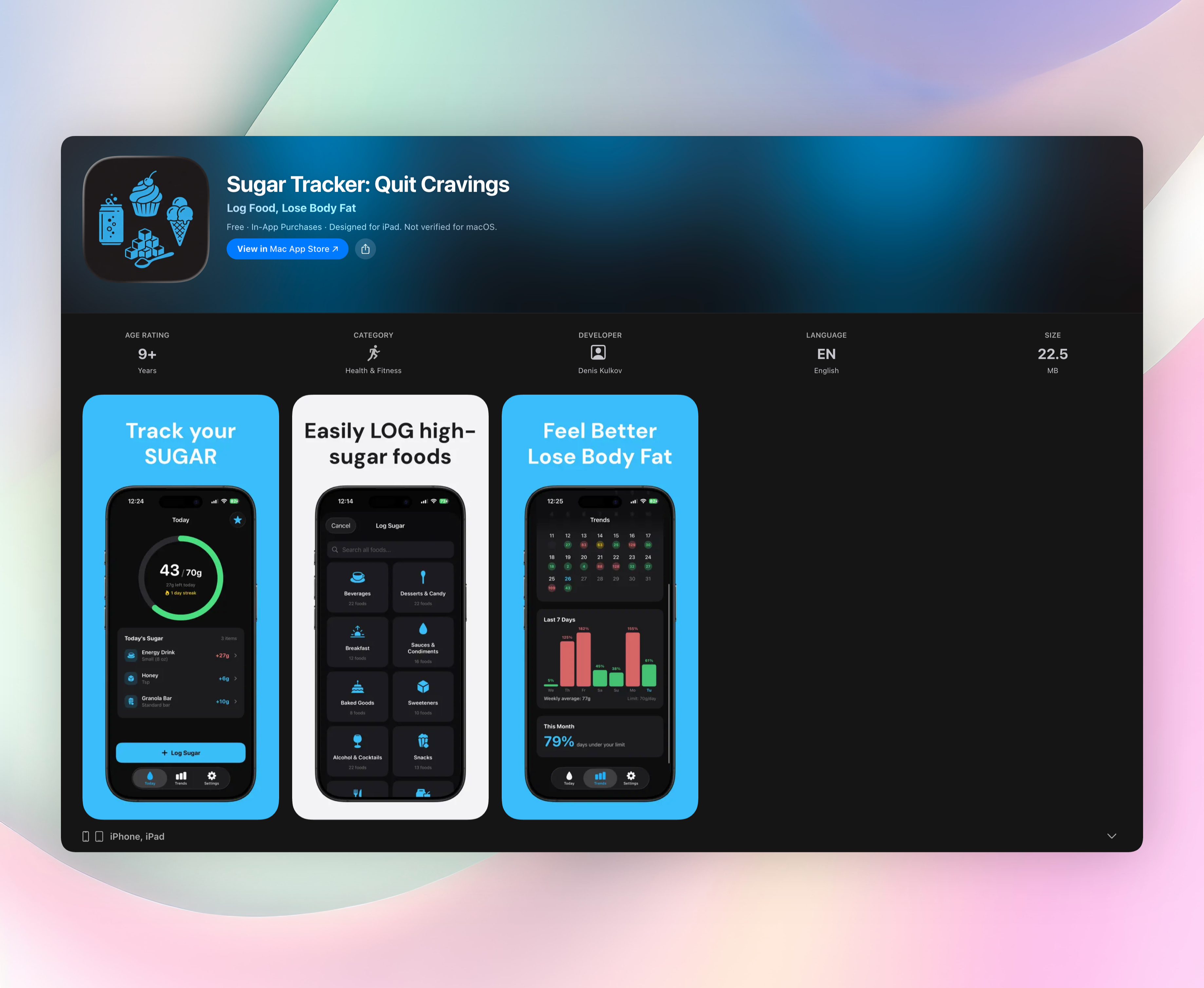
A taper beats stopping abruptly. Going 100 g → 60 g, holding a week, then 45, then 30 keeps the peak days from landing at all — you trade one rough week for a slower month. The catch: "cutting back" without a number usually means cutting back for three days. Sugar Tracker is an added-sugar tracking app for iPhone, which turns each step down into a figure you can check against instead of a guess.
The rest is unglamorous and effective:
- Put protein at breakfast. A breakfast of cereal, juice or a sweetened coffee sets up a mid-morning dip that reads as a craving. Eggs, plain Greek yogurt or last night's leftovers don't.
- Drink more water than feels necessary. Mild dehydration mimics both headache and hunger, and for many people a lot of that sugar was coming from drinks used for fluid anyway.
- Protect sleep. Short sleep raises appetite and makes sweet food more appealing the next day; a bad week of sleep undoes a good week of eating.
- Don't undereat. Cutting added sugar and total calories at the same time is what turns a manageable taper into a miserable one. Replace those calories with food you'd eat regardless.
- Change the cue, not just the food. If the craving is attached to a place or a time, moving the routine works better than resisting it — the tactics in stopping sugar cravings come down to that.
FAQ
How long does sugar withdrawal last?
Symptoms typically start within a day or two, peak on days 2–5, and are mostly gone by the end of week one. Taste and energy usually settle around days 10–14, though cravings fade more slowly and can show up situationally for weeks after.
Is sugar addictive?
Sugar activates reward circuitry and builds strong habits, but it isn't classified as an addictive substance in humans and has no clinical diagnosis. The behavior people call sugar addiction is real; the substance-dependence framing goes further than the evidence supports.
Why do I get a headache when I quit sugar?
The mechanism isn't settled. Proposed explanations include shifts in blood glucose handling and reward-related neurochemistry. Rule out two mundane causes first: less fluid intake if the sugar came from drinks, and less caffeine if it came from sweetened coffee or soda.
Should I quit cold turkey or taper?
Both get to the same place. Stopping abruptly is faster and rougher; a taper spreads the discomfort out and tends to hold better since the routine changes gradually. Taper if starting from a high intake or if you've abandoned attempts before.
Does fruit count when I'm cutting sugar?
The guidelines target added and free sugars, not the sugar naturally present in whole fruit and plain milk. Fruit juice does count as a free sugar under the WHO definition, even without anything added — that's the line the added vs. natural sugar distinction draws.
Free Sugar tools
- A1C CalculatorUse this a1c calculator to convert an A1C percentage to estimated average glucose, or enter average glucose to estimate A1C in both common units.
- Banana Carb and Sugar CalculatorFind how many carbs are in a banana by size, quantity and ripeness. Compare total and net carbs, sugar, fibre, calories and carb exchanges.
- Blood Sugar Level ChartEnter a blood glucose reading, unit and test context to see the published range, a chart position and the same value in the other unit.
- Blood Sugar Unit ConverterConvert blood sugar between mg/dL and mmol/L in seconds, with a two-column reference table for common readings.
- Daily Sugar Limit CalculatorEstimate a daily added-sugar limit in grams and teaspoons from your age, sex and calorie target.
- Sugar Cube Grams CalculatorFind how many grams of sugar are in a sugar cube by entering the number of cubes and grams per cube. Get the total sugar and an optional teaspoons equivalent.
- Sugar Grams to Teaspoons ConverterHow many grams is a teaspoon of sugar? A level teaspoon of granulated white sugar weighs about 4.2 g, while nutrition labels round it to 4 g. Convert either way, pick your sugar type, and see how the result compares with the American Heart Association daily added-sugar limits.