
Does sugar cause inflammation? What high intake actually does
High added-sugar intake does raise inflammatory markers, modestly, at chronic high doses. But the question does sugar cause inflammation gets more attention than the evidence supports — the well-replicated effects of too much sugar land on triglycerides, liver fat, blood pressure, and visceral fat. Dose decides all of it.
The claims about sugar, ranked by evidence
The claims don't sit on the same footing. Some come from controlled feeding trials where researchers set the dose, some from cohorts that can't separate sugar from the calories and body weight it travels with, a few from cell chemistry that never reached a trial.
| Claim | Evidence | Dose it needs |
|---|---|---|
| Higher triglycerides | Strong, controlled trials | Weeks of fructose-heavy intake |
| More liver fat | Strong; reverses on restriction | Weeks of high intake |
| More visceral fat | Strong at high doses only | ~25% of calories |
| Higher blood pressure, lower HDL | Moderate | Sustained high intake |
| Raised CRP, inflammatory markers | Moderate, tangled with body fat | High intake, plus fat gain |
| Gout flares | Strong, via uric acid | Sweetened drinks, repeatedly |
| Joint pain (non-gout), skin aging | Weak or mechanistic only | Not shown in trials |
How much sugar is too much?
The published limits differ in what they count, so they aren't interchangeable. The World Health Organization recommends keeping free sugars — added sugars plus the sugars in honey, syrups, and fruit juice — below 10% of total energy, with a conditional recommendation to go below 5%. The American Heart Association counts added sugars and sets a tighter ceiling: 36 grams (9 teaspoons) a day for men, 25 grams (6 teaspoons) for women. The US Dietary Guidelines use below 10% of calories for everyone over age two, and the % Daily Value for Added Sugars on a Nutrition Facts panel is calculated against 50 grams. The gram-by-gram version and the line between added and natural sugar are worth knowing first.
National intake surveys put the average US adult near 17 teaspoons of added sugar a day, roughly 13% of calories. That sits above both guidelines — and well below the 20–25% of calories used in the trials that produce the dramatic metabolic results.
That gap is why these outcomes look dose-dependent rather than binary. A large analysis of US survey data linked to mortality records found that, against people getting under 10% of calories from added sugar, those in the 10–25% band had roughly 30% higher cardiovascular mortality risk and those above 25% close to triple. It's observational and can't prove causation. The shape is the useful part: risk climbs gently through the middle of the range and steeply at the top.
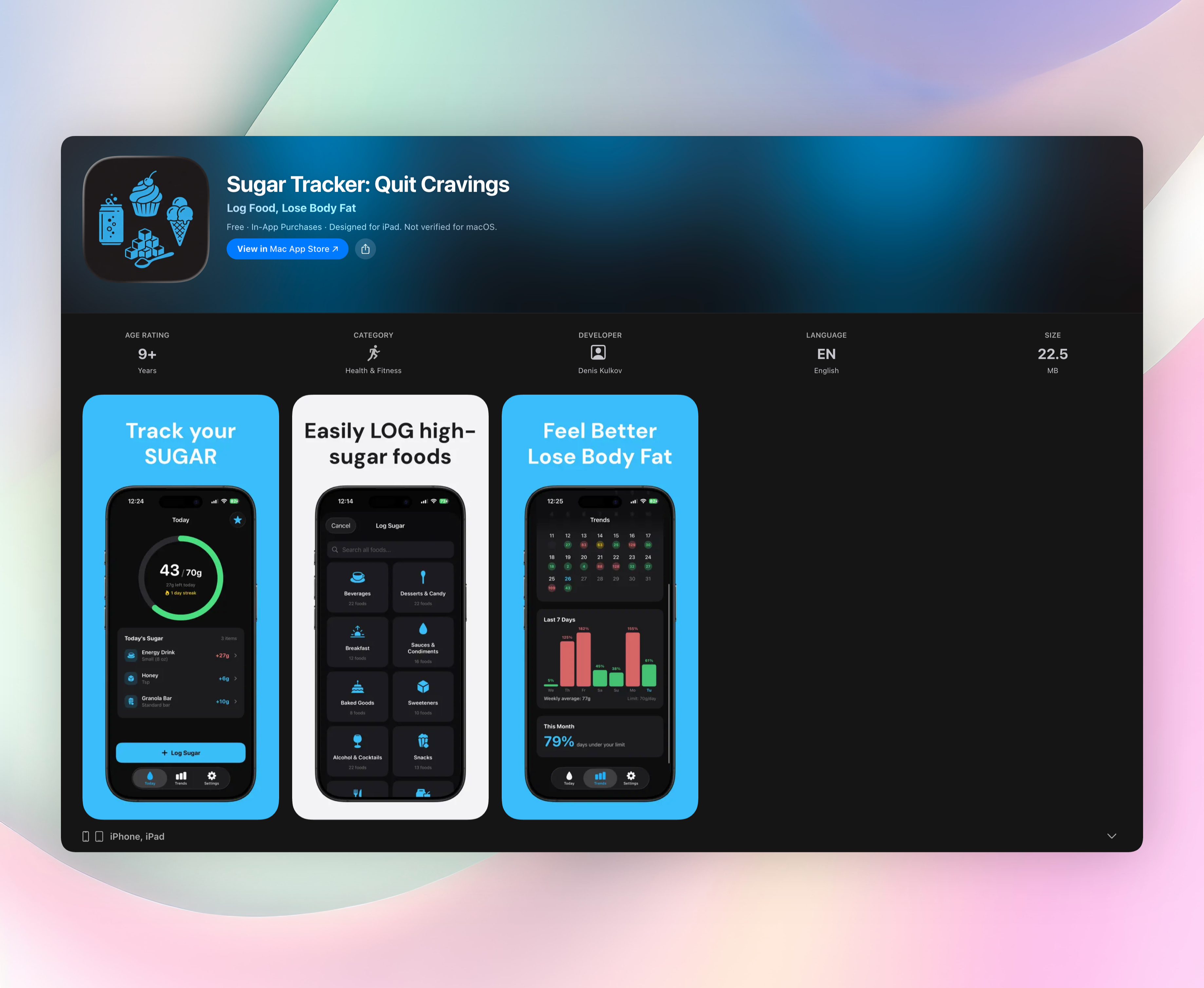
None of that is decided by one dessert; it's decided by an average, and most people's estimate of their own is off by a wide margin. A week of logging in Sugar Tracker, an added-sugar tracking app for iPhone, settles which side of the 10% line you're actually on.
Triglycerides, liver fat, and the fructose route
Fructose does most of this work. Glucose gets handled all over the body; fructose is cleared mainly by the liver, and when the liver receives more than it can burn or store as glycogen, it converts the surplus to fat. Some is packaged into VLDL and exported, showing up as higher triglycerides. Some stays behind as liver fat.
Both move fast. In an eight-week randomized trial, adolescent boys with fatty liver who cut free sugars sharply reduced liver fat, without weight loss doing the work. On sugar and cholesterol more broadly, the trial pattern is consistent in direction: triglycerides up, HDL down, LDL up a little. The LDL effect is the smallest and least consistent of the three.
Table sugar and high-fructose corn syrup deliver fructose in roughly the same proportion, near half, so the fructose versus glucose split matters more than the syrup-versus-sucrose argument.
Sugar and blood pressure
Cohort studies link sugar-sweetened drinks to higher rates of hypertension, and trials that raise sugar intake show measurable increases in systolic and diastolic pressure within weeks. The proposed mechanisms — uric acid, sodium retention, insulin's effect on sympathetic tone — are plausible and unsettled. The direction is consistent across studies, and the effect sizes — while modest — are largest at the highest intakes.
Sugar and belly fat, and does sugar cause weight gain
Sugar drives weight gain when it adds calories and doesn't when it replaces them. Trials where people simply cut free sugars saw about a kilogram of loss; swapping sugar for an equal number of calories from other carbohydrate changed nothing. Liquid sugar is worst: drinks trigger little compensation at the next meal.
Where the fat lands is a separate question. In a 10-week controlled trial, adults drinking fructose-sweetened beverages at 25% of calories gained visceral fat and saw worse lipids and insulin sensitivity, while a matched glucose group gained similar weight more subcutaneously. That's the basis for the sugar and belly fat claim — at several times the published limits.
Does sugar cause inflammation? What CRP shows
Weakly, and the confounding is severe. C-reactive protein and other inflammatory markers do run higher in heavy consumers of sugar-sweetened beverages. But adipose tissue, visceral fat especially, is itself an inflammatory organ, so any diet that adds fat mass raises those markers. Controlled trials that hold weight steady produce smaller, less consistent effects than the cohort data implies.
The indirect route is better supported. Sugar raises liver fat and visceral fat; both track with higher inflammatory markers and insulin resistance. Cutting added sugar plausibly lowers CRP through what it does to body fat, and mostly in people who were consuming a lot to start with. No trial has shown that an ordinary dessert measurably inflames anything.
The weak claims: joints and skin
The joint claim that holds up isn't arthritis, it's gout. Fructose metabolism raises uric acid, and sugar-sweetened drink intake tracks with gout risk in cohort studies — a specific mechanism. Generalized "sugar makes your joints ache" doesn't have that support.
Skin is thinner still. Glycation, where sugars bind to collagen and elastin, is real chemistry, but the jump from there to added sugar causing wrinkles hasn't been made in human trials. Acne has better evidence: small trials of low-glycemic-load diets showed modest improvement, which implicates glycemic load broadly rather than added sugar specifically.
FAQ
How much sugar is too much in one day?
The AHA's added-sugar ceiling is 36 grams for men, 25 for women. WHO and the US Dietary Guidelines use a percentage — under 10% of daily calories, about 50 grams at 2,000 calories — and WHO conditionally suggests under 5%.
Does sugar cause weight gain on its own?
Not when calories are held constant. Isocaloric swaps of sugar for other carbohydrate don't change body weight in trials, while cutting sugar without replacing the calories produces modest loss. Sugary drinks are the practical problem: calories without much fullness.
Does cutting added sugar lower cholesterol?
Trials on sugar and cholesterol show triglycerides falling first and most, HDL improving somewhat, and LDL moving least. Most of that response comes from cutting a high intake toward the guideline range, not from trimming an already modest one.
How fast do these effects reverse?
Liver fat and triglycerides are quickest, responding within weeks of a sharp cut in free sugars. Visceral fat follows fat loss and takes longer. Inflammatory markers trail body composition rather than leading it.
Free Sugar tools
- A1C CalculatorUse this a1c calculator to convert an A1C percentage to estimated average glucose, or enter average glucose to estimate A1C in both common units.
- Banana Carb and Sugar CalculatorFind how many carbs are in a banana by size, quantity and ripeness. Compare total and net carbs, sugar, fibre, calories and carb exchanges.
- Blood Sugar Level ChartEnter a blood glucose reading, unit and test context to see the published range, a chart position and the same value in the other unit.
- Blood Sugar Unit ConverterConvert blood sugar between mg/dL and mmol/L in seconds, with a two-column reference table for common readings.
- Daily Sugar Limit CalculatorEstimate a daily added-sugar limit in grams and teaspoons from your age, sex and calorie target.
- Sugar Cube Grams CalculatorFind how many grams of sugar are in a sugar cube by entering the number of cubes and grams per cube. Get the total sugar and an optional teaspoons equivalent.
- Sugar Grams to Teaspoons ConverterHow many grams is a teaspoon of sugar? A level teaspoon of granulated white sugar weighs about 4.2 g, while nutrition labels round it to 4 g. Convert either way, pick your sugar type, and see how the result compares with the American Heart Association daily added-sugar limits.